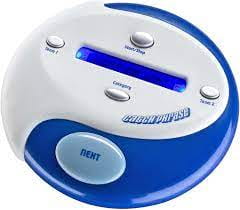
- Catch Phrase is a quick, talking, guessing game. There are two teams, so a minimum of four people. Teams take alternate turns. One teammate gets a word and has to describe the word without saying the word or rhyming with the word. The round is timed and the last team with the Catch Phrase device in their hands when the timer goes off gives a point to the other team. The first team to get to seven wins the game. The Catch Phrase generator has a 10,000 words and phrases, word list with different categories.
Potential barriers in the game:
- Time limit may not be adequately fair for every type of learner, especially those from different cultural backgrounds and languages.
- Difficulty of vocabulary / literacy level could be limiting. Cultural phrases and idioms could be niche culturally and generationally.
Who might be excluded:
- The generator is visual, so auditory learners could potentially be excluded.
- The time-limit could be too hard for some learners as it is fast paced.
- Personality type could affect the game. Extroverts versus Introverts.
- Difficulty of vocabulary / phrases could exclude learners such as ELL’s.
- People from different cultures could be excluded from different cultural and historical motifs.
- Second language learners could be challenged by vocabulary depending on how niche it is to academic or everyday language.
- Depending on the age of students (or the age gaps between people in the group), there may be some words or phrases that are behind or in front of their time.
How does the game foster creativity and critical thinking?
- Learners are forced to find different perspectives. They are not only accessing different vocabulary such as synonyms and antonyms, but also metaphors and similes.
- Because of the vast array of cultural signifiers, and the vast amount of content, the game provides a challenge for all participants.
- If you do not know the word or phrase, you have to try to describe it using other techniques.
- The time constraint fosters spontaneity and creativity and forces the presenter and the guesser to both think differently about language.
- Communication needs to be concise yet descriptive and it needs to match your audience.
What content is handled:
- Categories:
- “Everything” – all 10,000 words in the game
- “Tech/Inventions” – Anything that has been invented through the ages, from ancient history to modern times
- “History Buff” – History, politics, wars, civics, and things in the present that will become history
- “Entertainment” – Movies, music, books, actors, singers, authors, as well as fun activities
- “Sports/Games” – Sports and games of all sorts, leisure activities
- “Geography” – Places, both geographically and answers to the question “where?”; Also, things that are usually found in a particular place or region
- “Transportation” – Methods of transport, as well as things seen while travelling
- “Around the House” – Household items
- “Food/Drink” – Foods and drinks, cooking terms, ingredients, restaurants, other food items
- “Plants/Animals” – Plants, animals, items made from plants or animals
- “Family” – A subset of the words appropriate for children, no adult themes or terms
What skills are being activated:
- Critical (yet quick) thinking, creativity, communication
- Content: descriptive language, history, cultural motif knowledge, specialization in different topics
- Psychological: strategize with teammates, how to describe different scenarios
- Social: team play – how you work with others, personality traits, motivation
- Emotional: how you deal with pressure, failure, success
PISA:
Global competence works within four domains, including:
- Examine local, global and intercultural issues
- Catch Phrase is culturally limited with content and vocabulary.
- Understand and appreciate the perspectives and world views of others
- Mostly historically and word neutral.
- Engage in open, appropriate, and effective interactions across cultures
- Ability to succeed or fail encourages any participant no matter the cultural background.
- Take action for collective well-being and sustainable development.
- Promotes new knowledge and creativity.
Global competence builds on specific cognitive and socio-emotional skills, including:
- Reasoning with information
- Yes
- Communication in intercultural contexts
- Yes, in terms of mistranslations or opening up new dialogue about perception and definition. The vast amount of vocabulary to one culture requires background knowledge, so accessing that in different cultures would be very difficult. The language must match the culture, so a world version of the game would not be possible. However, vocabulary removed from context is quite neutral. Vocab word lists can also be tailored to specific lists or even self-created so in this way could be created to create more of an intercultural conversation.
- Perspective-taking
- Yes
- Conflict resolution
- Not really any conflict, N/A
- Adaptability
- Yes
Global competence includes:
- Openness towards people from other cultural backgrounds
- Yes, but could be culturally biased. The French version for example could be different from the American.
- Respect for cultural differences
- Not entirely in terms of phrases. Phrases dependent on supporting culture.
- Global-mindedness
- Yes, in the ways in which we must maneuver around language. No, in that the access to previous knowledge may be limited.
A test of “global understanding”:
- Background knowledge + cognitive skills necessary to successfully navigate global and intercultural issues.
- Not enough background knowledge to be fully UDL for all participants. Does creative intercultural conversation because it stimulates different perspectives. Vocabulary may be new or untranslatable for ESL learners.
- In terms of situated meanings, this could be positive. Situated meaning is defined within the context that people are better at learning when experiences are attached.
- It is pleasantly frustrating.
- Good way to encourage players to think about relationships, not isolated events, facts, and skills.
How will you assess learning is happening?
- Have students design the word lists themselves
- Informal observations of students demonstrating understanding of vocabulary.
- Reflection questions:
- How did the game help you learn?
- What words did you learn that you didn’t know before?
- Categorize words that were challenging or still need help
- Draw posters with vocab words from the game afterwards (pictures, definitions)
How can we use this in class?
- Catch Phrase can be used in class to review vocabulary words for a unit. Students will be able to give their peers examples and definitions of terms learned during class within the game. This helps check for understanding as well as makes it a fun learning opportunity for the entire class.
- After the game has ended, the teacher can further the lesson by asking students to categorize vocabulary words as easy, medium, and hard. Teams can then be created to create posters consisting of the words, definitions, illustrations, and examples to share with their peers.
How can we adapt this to be better suited for all?
- Catch Phrase can be adapted by showing a photo that needs to be guessed instead of the word spelled out for children with reading difficulties.
- Begin with easier words and increase to more complex, harder to define words instead of them being drawn at random.
- Increase the time limit if it is needed.
- Turn off the buzzer sound to decrease anxiety.
- Language, generation, and culture questions can be adjusted for the specific situation.
- Limit metaphors and slang that non-native language speakers might not know.
- Print size can be larger for those who have a difficult time seeing small print.
16 learning principles of good games:
1. Identity – There are two different identities in Catch Phrase. The player who knows the word or phrase (clue-giver) and the players that do not (guessers). There is a competition between the teams which invests the players to band together and overcome their opponents. Players don’t want to let their teammates down either.
2. Interaction – Players of Catch Phrase are constantly interacting. Clue-givers must support their teammates by giving hints and examples that will lead them to guessing the correct word. Guessers are always engaged and ready to guess, guess, guess and pass the device.
3. Production – Catch Phrase gives players complete control over the production of the game. The only part they cannot control is which word is given to their team. (In an adapted game, players could create their own word lists which would give them an added production role!)
4. Risk-Taking – Players can take risks in Catch Phrase by trying to define words that they do not know the definition to. They can do this by breaking apart the word in order to have their teammates guess how to put it together. Each time the guesser guesses or the clue-giver gives a clue, they’re taking a risk by putting their thoughts out into the game realm. However, the game is fast-moving and can quickly change so the risk is low, but the reward is sweet! If you make a mistake or can’t guess it, it is easily laughed off and the game continues.
5. Customization – Players can customize this game by giving different examples, definitions, and also using movements and gestures to convey a message to their teammates. (In an adapted game, players could create their own word lists which would give them an added customization role!)
6. Agency – Agency is easily created during Catch Phrase because players must take ownership over the words they are trying to convey to their teammates. They feel a sense of urgency and responsibility to their team as well.
7. Well-Order Problems – In Catch Phrase the words are given at random and do not “build up” in level of difficulty so players do not have the opportunity to work towards guessing harder words as they progress throughout the game. This is an adaptation that could be made to the game in order to make it more beneficial to players.
8. Challenge and Consolidation – There is a bit of a skill that builds as players play Catch Phrase. Players learn new ways to explain words or phrases that they’re unfamiliar with by using collocations, personal experiences, homophones, and more. As teams work together, they start to understand each other’s “language” and can guess quickly and effectively.
9. “Just in Time” and “On Demand” – There is no “just in time” or “on demand” learning in this game. This does demand that players think of information quickly and without much pause, but it doesn’t offer assistance in defining the words. Most teams will skip a word or phrase if it is too difficult without ever returning to it to learn what it meant.
10. Situated meanings – There are categories that are chosen before the game begins that help give a “situation” to the words that follow. There aren’t any other details provided for each specific word though.
11. Pleasantly Frustrating – This game meets the pleasantly frustrating criteria perfectly. There are multiple factors that can make it frustrating such as a timer going off milliseconds before a teammate guesses the correct word, but these moments usually lead to the entire group laughing and even more determined to win the next round.
12. System Thinking – Players must think about their teammates and how slowly or quickly they need their team to guess their word. Sometimes players may intentionally slow down to give the next team less time to guess the word. They need to work together and pay close attention.
13. Explore, Think Laterally, Rethink Goals – Players need to think which clues will help their teammates guess their word the quickest. They may need to redact their first attempt and try another way if their teammates aren’t picking up on their clues.
14. Smart Tools and Distributed Knowledge – The knowledge is distributed throughout the team as the clue-giver must give clues that are appropriate for their guessers. Sometimes teammates may give clues to specific people on their team that might understand it best (age, personal experience, commonality, culture, etc.).
15. Cross-Functional Teams – Players must work together to pass off the Catch Phrase device. The clue-giver and the guesser are equally as important. They each take turns giving clues and guessing so they know the pressure from both sides. This helps them to be more effective in each role because they know how it feels to be in that role.
16. Performance Before Competence – Players must perform the word and give multiple different clues toward the correct phrase before their teammates guess it correctly in most cases. It is rare that there is just one word that sets off the guesser, so the more details, clues, and hints you can give the better it is!
Played & Evaluated by: Brooke, Jillian, & Brittany
FSU Bangkok Cohort, Summer 2021