Jackbox is an online platform that allows users to stream multiple games. They can be adjusted for single or multi-use depending on the game that users decide to purchase. It is a gaming company that has always been conducive to social collaboration. Some games are for more personal relationships, requiring “inside” knowledge of a person, but some games are for all (including strangers!). This company really became popular during the pandemic, when all we had was communication and entertainment via a screen.
The Rules
Go to jackboxgames.com.
Select the game for purchasing and download STEAM.
Check your email for the access code (to your purchase). Create an account with STEAM and enter your access code to start the game.
Go to jackbox.tv and enter the room code on your cellular device.
Once users have created their own usernames and drawings, you are ready to PLAY!
What is Drawful 2?
The object of the game is to contribute drawings to be interpreted by your group. Chances are the artist may get ridiculously wrong answers! Users can log in by using their phone or tablet to draw funny and challenging things like “peeping donkey” or “cats at a disco.” Once logged in, players type in what they think the drawing is and then everyone contributes their answer. The drawer will choose the closest answer and that person will gain points.
Potential Barriers
Technology access: The App had different results depending on the OS on the device.
Linguistic Understandings: The game operates on English western logic, meaning that multiple meanings that would be easily surmised by a native English logic might need to be explained.
Motor skills and spatial awareness: The game requires individuals to apply a slight level of movement, which some students might feel reluctant to start altogether. Rather common in classrooms when there are assignments that require illustrations.
Who might be excluded?
Technology proved to be the main factor of exclusion. The application required multiple steps to set up for the entire group. It demanded the creation of a variety of logins and accounts for full coordination to happen.
Students who are shy at artistic self-expression would be a lot more hesitant to fully participate. Oftentimes students who are not adept at quick applications of art will feel judged despite the comedic element of the game itself. This can happen with students who are perfectionists by nature.
How does the game foster creativity and critical thinking?
This game absolutely fosters creativity. The whole objective of this game is to interpret a simple saying and draw how we interpret this. Obviously each individual has a different standard of drawing, so the creative aspect will have many different deliveries. Artists must critically think of how to deliver content in a way that can be understood by others. Players must put their minds in the artist’s and think how the provided prompt should be delivered.
What content is handled? What skills are being activated in the game?
How the game plays: everyone is given separate prompts, and has to draw an image matching that prompt. Then, the other players attempt to figure out what the drawing is, and write their own description. The most convincing description—the one all the other players vote for—wins that round.
The game activates the following skills:
Content can be created by students after reviewing the learning material in an anonymous form. Students will contribute to the subject target by creating visuals that can represent what was learned. Students rely on their prior knowledge to interpret an image with limited context. This requires critical thinking of each contributor.
Assessment of Learning
The learning in this game can be assessed when users are utilizing their logic to identify what pictures others users are creating. Users could be assessed on how well they present the picture through the game and how swiftly they are able to respond to the content that team members create. The created drawing will obviously display the understanding of the required prompt.
The game requires players to input titles for the illustrations. The students would have to refer to concepts from the learning material. Whether they are wrong or not, it does not matter as long they are approximating the concepts for further review and clarification.
The ability for the application to create its own specific concepts means this game can be used for any subject in a very efficient form. It is also very friendly for phone use, only requiring one host on a computer to operate it.
Takeaways
At first, the game was really difficult to understand how to download as we were all unfamiliar with how to use the platform STEAM. However, after a forty minute zoom, we were able to log back on to zoom and figure out how to start the game. We thoroughly enjoyed it and found that this could be especially beneficial for more complex subjects (science, historical events). Here are some highlights from us playing the game below.
By Angel Tillery, Amber Yafang Pang, & Judy Ying Zhu
About Wordle:
Wordle is a browser-based word guessing game, there’s no app to download, you just visit this website and get cracking. (You may need a certain VPN, or virtual private network, to access this website. If you are not able to access the site, here is an alternative link here.) The game gives you six chances to guess a five-letter word and each day the page is updated with a new word. The word is the same for all players globally.
Materials:
Any device with internet access
A notepad / paper
Rules:
The rules are very simple. You can play by yourself or in a group with others. All you need to do is use process of elimination to figure out what the final word is.
If we want to incorporate this game as a learning tool for students, we can use a point system:
At the end of a few rounds, we can see who has the most points!
In Wordle, we’re all winners!
Let’s see what happens when three friends get together for a good virtual session of Wordle.
Angel, Amber, and Judy play Wordle
According to James Paul Gee’s 16 Learning Principles of Good Games, this is how Wordle can be applied:
1. Identity: In this game, the players take on the identity of a game player, whether it is a single player game, a versus game, or a game played in groups in a “competition-style” game. When playing the “Word of the Day” Wordle, each player is involved in playing the same game in every part of the world; according to an article written on game blog fictionhorizon.com, Wordle had a daily user base of about 300,000 users a day during its peak in early 2022, before ownership was transferred to The New York Times (Jeijei, 2023).
2. Interaction: Wordle allows you to interact with people in many different ways:
You can play with a group of friends, working together to figure out the word
Students can play in teams, using a point system (orange letter 1 point, green letter 2 points, and full word 5 points) to compete for prizes for the most points
You can play the same game individually online through a website and share your results with other players on social media
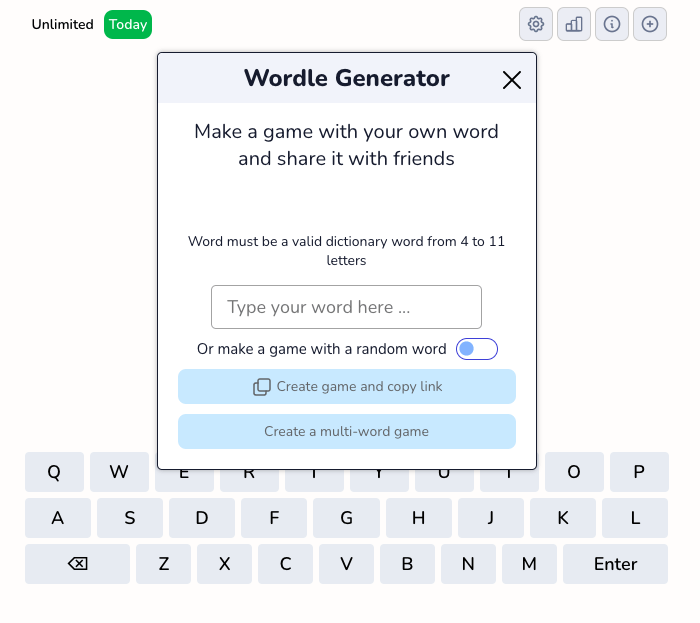
3. Production: If players want to challenge others to a word of their own, they can create their own Wordle game on the https://wordleplay.com/wordle-for-kids webpage by clicking on the (+) icon at the top right of the page. If we want to take Wordle off the screen and onto paper, it is very easy to set up a Wordle-like game (also could remind you of the class game “Hangman”) on a whiteboard, chalkboard, or even a piece of paper.
In the process of playing a Wordle game, it is easy to start creating our own words and mixing and matching letters together to guess a word we may have never heard of. During this process, our brain is producing and building words together, like one would in the BBC educational series Alphablocks, and using phonics and the process of elimination to produce the hidden word.
4. Risk-Taking: Wordle is all about risk-taking–it doesn’t matter if you get the answer wrong the first or second time because you have six tries to get it!
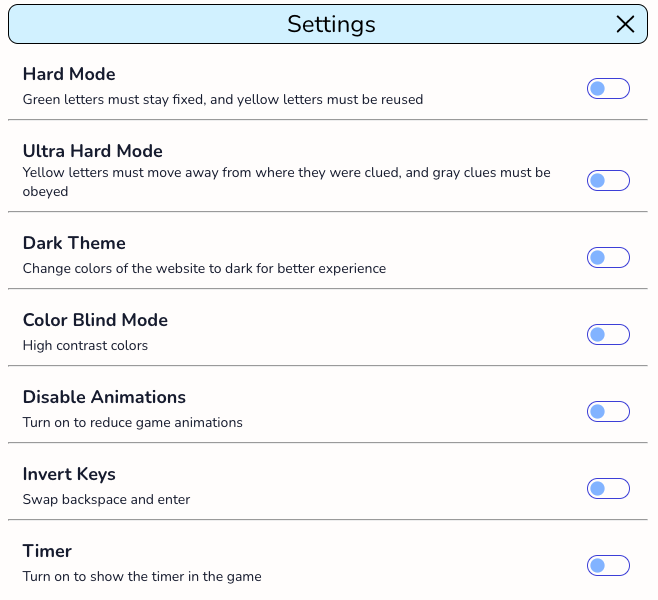
5. Customization: As discussed in the production criteria above, there are many ways to play the game, which means that the game can be customized to fit the player’s expectation. For example, those who find the standard version of Wordle too easy can switch their settings to hard mode, where every time the players reveal a letter, they must use that letter in any subsequent guesses, limiting their options to find as many clues as possible in the first few guesses. Also in the settings options, players can find colorblind mode, introduced after user feedback which explained some players could not spot the difference between green and yellow squares, colorblind mode changes the squares to more contrasting colors – orange and blue – making it easier to identify where letters should be placed.
6. Agency: In terms of agency, Wordle provides players with a high degree of autonomy and control over their learning experience. Players can choose to play the game at their own pace and within their own comfort level; this enables them to customize the game to their ability level and challenge themselves at their own pace. In addition, the game provides players with instant feedback on their performance, allowing them to learn from their mistakes and adjust their strategies accordingly. This feedback is critical to helping players develop problem-solving skills and improve their performance.
7. Well-Order Problem: In Wordle, players must use deductive reasoning to eliminate possible answers based on the feedback provided by the game. The process involves using trial and error to eliminate possibilities and make educated guesses based on the available information.
8. Challenge and Consolidation: Wordle presents players with a challenge by asking them to guess a five-letter word in a limited number of attempts. This challenge requires players to use problem-solving skills and logical thinking to eliminate possibilities and make educated guesses based on the available information. After each guess, the game provides feedback to the player, indicating which letters are correct and in the correct position, which letters are correct but in the wrong position, and which letters are incorrect. This feedback allows players to consolidate their understanding of letter combinations and improve their problem-solving skills over time.
9. “Just in Time” & “On Demand”: In Wordle, the “On Demand” approach is evident in the immediate feedback provided to players after each guess. The game provides players with information about which letters are correct and in the correct position, which letters are correct but in the wrong position, and which letters are incorrect. This feedback is provided in real-time, allowing players to adjust their approach and make more informed guesses in the future.
The “Just in Time” approach is evident in the limited number of guesses allowed in the game. Players must use their problem-solving skills and logical thinking to make educated guesses based on the available information, and are given only a limited number of attempts to do so. This approach promotes efficient learning, as players are encouraged to think critically and strategically about their guesses, rather than simply guessing randomly.
There is also a choice to “give up” if a player really cannot think of the answer. This gives the player an opportunity to end the game when they need and get the answer when they ask for it.
10. Situated Meanings: In Wordle, “Situated Meanings” can be seen in how players use their knowledge and understanding of language and vocabulary to make educated guesses about the five-letter word. The meaning of each letter is situated within the context of the other letters in the word, and players must use their knowledge of language and vocabulary to make sense of the word and its meaning.
11. Pleasingly Frustrating: In Wordle, the enjoyable frustration is reflected in the limited number of guesses allowed for each word. Players must use their problem-solving skills and logical thinking to make educated guesses based on the available information, but they are also given a limited number of attempts. This challenge creates a sense of tension and excitement that keeps players engaged and motivated to continue playing.
In addition, the game provides instant feedback after each guess, and this feedback allows players to adjust their approach and make more informed guesses, adding to the “enjoyably frustrating” nature of the game.
12. System thinking: In addition to vocabulary accumulation, players also need to have system thinking to help them win a game, which is to give meaning to these given letters from a big picture: what could be the connection between them, and if I choose a letter, how will it affect the following choices?
13. Explore, Think Laterally, Rethink Goals: To submit every word (hypothesis) of the six, players need to explore laterally for as many possibilities as they can, before moving down linearly. If the submitted word is incorrect, players need to reflect on and rethink the hypothesis and make adjustments accordingly.
14. Smart Tools & Distributed Knowledge: Playing this game, the players, us on the other side of the computer, tablet, or smartphone screen, work well together with a set of virtual characters inside the screen, the keys and colors on the Wordle keyboard, and use our knowledge of language and phonics in cooperation with the clues given by the smart keyboard to figure out the hidden word.
15. Cross-Functional Teams: As mentioned earlier, Wordle can be played in teams. Multiplayers in cross-functional teams help each other win the game efficiently. Some people have a relatively large vocabulary, some people are good at logical reasoning, some people are more familiar with consonant combinations, and some people learn phonics well. By understanding your own and other individuals’ skills, positively communicating and collaborating, players contribute each specialty to the success as a team.
16. Performance Before Competence: One player can play Wordle before he/she has competence in English vocabulary. Players can perform in the process of playing Wordle, by trying, getting timely feedback, interacting with group-mates, and achieving competence by constantly improving performance.
Stay inclusive, stay accessible, LET’S LEARN!
What are the barriers in the game?
The students have limited English vocabulary and knowledge of spelling patterns might get frustrated.
To play Wordle with papers and pens, untimely and incorrect feedback from the teacher/game host would affect the progress of the game.
The five-letter word in Wordle is an anagram, meaning it is a word formed by rearranging the letters of another word. Some players may struggle with anagrams or find it difficult to recognize the correct word from the scrambled letters.
Players have a limited number of attempts to guess the word, which can create a sense of time pressure and make it difficult to think through possible answers.
Who might be excluded?
To play Wordle, a device such as a computer, tablet, smartphone, etc. with access to the internet is needed; players who do not have access to these devices will not be able to play. If you want, you can play a pencil and paper alternative, but this only works in a multiplayer game.
The game uses the English language, therefore, individuals who do not speak or understand English may find it difficult to play and enjoy the game.
The game is text-based with no visual cues. Individuals with visual impairments may find it challenging to read and engage with the game, or even may not be able to play it at all without aided help.
How does the game foster creativity and critical thinking?
Have a different setting for the one game
Explore combinations of letters according to certain rules
Players must generate hypotheses or possible answers to the puzzle based on limited information, such as the number of letters in the word and any letters that have been correctly guessed.
Playing Wordle can help to expand players’ vocabulary by introducing them to new words and challenging them to recognize and use these words in context.
The game allows players to learn from their mistakes by providing feedback on incorrect guesses. Players must use this feedback to adjust their hypotheses and improve their chances of guessing the correct word.
What content is handled? What skills are being activated in the game?
The content handled could be English vocabulary, spelling and phonics in any level.
By playing Wordle, these skills of students could be activated: creativity and critical thinking, communication and interaction with other players, and deductive reasoning.
How will you assess if learning is happening?
The game statistics are the most direct form of assessment. The percentage of wins and how low the best try is can tell if learning is happening during the game. Since the teacher can make a game with a specific series of words, he/she can pick the words that students didn’t learn well to teach and play again later.
Of course, the teacher always can observe students while they are playing in the class, to assess what skills have been used in the process.
There are many ways to use Wordle as a fun learning tool in and outside of the classroom. We would love to hear about your Wordle experiences! Please share with us in the comments section below.
By: Chelsea Yangirelfil, Maria Simeon, and Yijia Zhao
Description: The main objective of the module is to explore and analyze a game as a creative multimedia technology. The goal is to explore how games can be creatively utilized to address skills objectives and meet existing standards. Games and play are great because they typically involve multiple domains of learning simultaneously and seamlessly: psychological, social, emotional, as well as content.
Escape Room
Objective of the Game: Students will be able to explore and answer questions to escape the pirate ship.
Game Site: https://online-escape-room.com/
Escape Room Introduction Video
Escape Room Game Play
Escape Room Discussion
Escape Room Bloopers
Questions To Consider
Question #1: What are the barriers in the game?
Internet speed – Without fast-speed internet, the game cannot be streamed. So students without internet access or fast internet might feel frustrated and excluded in the game.
Lagging computers – Frozen screen and lagging computers might add to the frustrations.
Lacking devices – Students need to have at least one digital device to play the virtual Escape Rooms game. The device can be a smartphone, iPad, or laptop.
Only one screen – When playing the game, we realized it would be so nice if we could have multiple screens, for example, one screen for the map, one screen for the clue, one screen to answer the questions, etc. Having multiple devices could be really helpful. That’s why we encourage teamwork.
Limited open-ended questions – The questions we answered cover a variety of subjects, Math, English, science, however, most are not open-ended questions. We need to think of ways to incorporate more open-ended questions into the game.
Limited space – If we were to design/create a physical escape room, limited space in school/classroom is a challenge.
Time consuming – it is very time-consuming when teachers or students try to design/create the game. Teachers might want to work as a team. It can be an end-of-the-year group project for students as well.
Question #2: Who might be excluded (without proper support)?
ELL students who might have difficulty understanding the language spoken, and the text displayed in the game. When we are grouping the students, we need to take that into consideration.
Some students with IEP might be excluded if there is no proper support. For example, some students might need the text displayed to be read out loud.
Questions #3: How does the game foster creativity and critical thinking?
Students get to explore and problem solve throughout the game.
Students are retrieving prior knowledge when answering questions.
Students are thinking outside the box.
Students can reflect on their learning and relate it to real-life situations.
We can customize the game so there are more ways to “escape”. We can also design it to adapt to students’ learning styles.
The game has a theme (for example, the one we did in the video was called “Pirate Panic”). We can have different themes and give students choices to choose one or create their own theme.
Questions #4: What content is handled? What skills are being activated in the game?
We can include a variety of subjects. The questions in the Escape Rooms game can be for any subject areas (for example, the game we played had math, cardinal directions, Language/Vocabulary). We can also include Social Studies and Social Emotional Learning (SEL)
Skills being activated :
–Problem-solving
–Critical thinking
-Teamwork
–Awareness skill (be aware of your surroundings)
–Creativity
Question #5: How will you assess if learning is happening?
We can assess student learning throughout the game when students are answering the questions and figuring their way out.
We can assess the language used during the game.
We can assess the interaction and teamwork between the students.
Gee’s 16 Principles
Identify – Provide students character profiles or identification that are connected to the escape room’s subject.
Interaction – To unlock the series of tasks, students must interact with one another and exchange knowledge.Students work as a team (one leader, two supporters) and they can communicate and solve problems together.
Production – Students can take part in creating the hands-on interactive creation of the “escape rooms”.
Risk Taking – Educate students to decision-making or timed problems that need risk-taking. Students are able to take risks and continue playing. They can try the game again even if they fail.
Customization – Offer many paths for resolving riddles or optional challenges to give students the option of customizing their gameplay experience. Students can choose game sets that align with their interest and subject matter allowing them to be more engaged.
Agency – Identify opportunities for students to make decisions and take actions that directly affect the game.Students get to choose a theme for the game and they can also take part in creating the game, so they have a real sense of ownership over what they are doing.
Well-order problems- Create challenges and riddles that get tougher over time so that students can improve their abilities and knowledge as they move through the game. The Escape Room Games will have step by step instructions and questions for the students to answer in order. They are able to either answer them in order or to explore freely.
Challenge and consolidation – It allows students the chance to reflect on what they have learned after surpassing the challenges.The Escape Games will not have the adaptive system to create questions created for each specific student. The questions are already set.
“Just in Time” or “On Demand” – The hints (“on demand”) are placed when students get stuck on a problem, they have the option to get help (sometimes it is limited from 2 up to 11 hints) and these hints are useful. When we answer a question correctly, we get the clues “just in time”. These clues should be properly placed to offer help when it’s needed, ensuring that students get help just in time to keep the game moving forward.
Situated Meanings – Students can match the obstacles and riddles to the escape room’s general concept and narrative. They are able to utilize and learn different vocabulary words as they explore. They are able to relate the words to the events and images or symbols in the game.
Pleasantly frustrating – Create tasks that are challenging enough to encourage students to use their critical thinking skills and to persevere and explore in order to find solutions. The game is doable but challenging. Throughout the game, we get stuck on certain questions but eventually we figure it out as a team.
System thinking : Students need to manipulate and comprehend the causal connections about what events will happen from their decisions. As they explore and solve questions, they will think critically about how the game will react as well as their team players.
Explore, think laterally and rethink – The game gives the opportunity for exploration and discovery as they try to escape. Students can go back and forth through the questions and hints to help them solve the problems.
Smart tools and distributed knowledge – Students can use digital tools such as tablets and laptops and software designed for cumulative data and record keeping, simulating real data learning and integrating the game-like experience to improve educational results.
Cross functional teams – It is a multi-player game. Students get to play in teams and each player has a different set of skills (teacher can keep that in mind when grouping students).Teamwork and knowledge sharing are crucial to succeed.
Performance before competence-“Learning by doing” Students can learn to play the game while exploring the game. Students are performing all throughout the learning process. They learn through exploration and go beyond what is expected.
Escape Room Experience in Seoul
I was able to travel to Korea in April and experience an actual escape room. It was amazing and the riddles were very fun to solve. Communication and Teamwork was a big factor in solving the riddles and escaping the room. Comparing the two experiences (online and physical), each of them has their own advantages and disadvantages. Both of them encourage a lot of problem solving and critical thinking. It was also challenging and involved a lot of prior knowledge retrieval. Students would definitely enjoy these types of games in the classroom.
Andrea Haeussler: Middle School 6th, 7th & 8th Grade
Angelique Vives: Yearbook Class 9th, 11th & 12th Graders
Games played by Lucia, Andrea & Angelique
123, ABC
Students sit in a circle. The teacher or the started starts counting with 1 and passes it to the right. The next person passes 2, then the next one 3, and so on. When the student reaches 20, the next one starts with 1. Once the counting has been established, the teacher or started passes the ABC to the other side (opposite to where the numbers were sent). And the same process happens.
This is a spoon
Similar to the 123, ABC game. The teacher or starter starts the round going to the right (or left) passing a spoon and saying: “This is a spoon”. The person next to them says “A what?” Teacher responds: “A Spoon”. Studnet says “Oh, a spoon” and passes it to the next person, following the same dialogue. After about 2 or 3, the started passes the fork to the other side and follows the same dialogue.
Categories
Students stand in a circle. A category is selected. For example, countries. Everyone must say a topic from the category, in this case, a country. Rules: they can’t repeat the countries, they have to say it fast (no more than 3 seconds to think) and they have to be correct. If any of the rules are broken, they must sit out.
Connections
A person starts by saying a word, any word. The next person has to say a word that connects with the last word said. So if the first word was clouds, the next one can be sky. Then, the following person must connect to the last word said, so sky (not clouds). And so on. Rules: they can’t repeat the words, they have to say it fast (no more than 3 seconds to think) and the words have to connect and make sense. If someone makes a mistake, they must sit out.
Game played by Antonio Mayornick
Pictoword: Grade 6 (11-12 year olds)
Students read a series of pictures that combine to create a word. The series of pictures can be very simple and direct or the teacher can make it more challenging by making each syllable a different picture. The difficulty can also be increased by choosing pictures that don’t sound exactly like the word students are trying to figure out. A very simple example would be a picture of a stick of butter plus a picture of a fly. This word would be butterfly. A more difficult approach would be:
Students can play on teams or individually, the first person or team to say the correct word gets a point. If you’re writing the words on dry erase boards, teachers can have spelling count to earn the point.
What is Roblox? Roblox is an online platform for players to create games or play games other people have created, explore virtual worlds, and socialize with friends (or strangers).
Rules – Roblox has a set of Community Standards for all players as they interact with the many games and other players that are accessible on the platform. These community standards are broken into three categories; Safety, Civility & Respect, Fairness & Transparency, and Security & Privacy. Overall, Roblox encourages its community members, known as Robloxians, to “treat everyone with respect, both on and off of Roblox.
Objective – Roblox’s objective is to “build the metaverse: a space for people to adventure, experience, and explore.” It is a global community and Roblox wants to “ensure everyone feels welcome and safe and is treated with kindness and respect.”
Evaluation of the gameusing Gee’s 16 principles:
Identity- Players are able to build their avatar according to their own preferences. With Robux, players can purchase add-ons that further individualize their avatar. Due to the nature of virtual games, players can be anyone they want to be while playing Roblox!
Interaction- In Roblox games, there is a chat function where players may interact with one another. Each game is different, but in some of the games I tried playing, there were rules presented to me along the way. As I approached new stages or levels, new challenges were introduced.
Production – While there are many games available for play, some players choose to create and publish their own.
Risk Taking – Most games on this platform have a “checkpoint” feature, which allows players to reattempt portions of the game by trial and error. Users have the ability to take risks knowing there isn’t too much to lose.
Customization – Players can customize their avatars, they can create their own groups to play games, and they can create their own ”place” in the Roblox Studio. This “place” is similar to minecraft, where players have their own land and structures to personalize. The studio is where users can learn how to alter, edit, and design in their space and eventually their own game. Some games have different characters you can choose to play and you can customize their outfit in that specific game.
Agency – The players who choose to create their own games for others to play gain a strong sense of ownership and control over their own creation. For example, in “Theme Park Tycoon 2”, the owner has control over what they are doing and creating within the boundaries of the game. There are many creative features to adjust and explore within the game.
Well-Order Problems- There are levels or “stages” in games that are built on by prior stages. In Cotton Obby, for example, you learn to navigate on the first platform and all following platforms become more and more difficult to navigate. The skills are being built upon in each stage.
Challenge and Consolidation – You die in every game but there is the option to restart at the checkpoints you have passed.
“Just in Time” or “On Demand”- There is very little in the way of instruction or direction when you start a game, though in some of the games played, a character will tell you the directions for the level/stage you are currently working on. In other games, you can click a button that will allow you to read about game play upon your request only.
Situated Meanings – In “Scuba Diving at Quill Lake,” there are many places to explore and new vocabulary to learn throughout the game. Players can choose different areas to explore. Each area has specific landmarks, gear, and vocabulary for players to understand. The vocabulary is repeated and reinforced through images and actions within the game. This makes it very applicable and meaningful for players to explore and understand.
Pleasantly frustrating- Elements of this game can be frustrating, like not having control of your character or not being able to complete the task. You do “die” during the game, but then you come back to life and can try again. If a game is too frustrating, you are able to exit the game and find a different one to play. Some are much easier than others.
System thinking – Roblox has its own in-game currency called Robux, you can earn by creating games or by purchasing a gift card or subscription, which can be used to buy membership access to the Builders Club. With this, players can customize their character, known as an avatar, and improve their experiences in the game. Players engage in an exploration of Robux and what they create on the platform. How can they make money from what they create?
Explore, think laterally and rethink- Players can explore a variety of games, experiences, and skills. Since there are secrets hidden in games, players are encouraged to explore the entire map or capacity of the game before moving on.
Smart tools and distributed knowledge – Within the Roblox Studio, users design and interact with smart tools to create their own space. Users can design using Geometric or Physical planes, where you can account for collisions and other technical considerations.
Cross functional teams – Players can play games with other users they invite, or with anyone on the platform. Depending on the game, players have certain tasks to complete or roles to assume.
Performance before competence – Players can play any game on the platform before they ever decide to attempt to create their own game. Most games are exploratory and require players to navigate and explore the content before interacting with the game specifically.
Universal Design for Learning (UDL) Assessment
Reflection:
What are the barriers to the game?
The game has a Roblox Studio where each user can customize their own “place.” No navigation tutorial is provided.
Most customizable options or games require players to make a purchase.
Lack of prior knowledge about the game.
Only offered on computer, ipad, or cell phone. On the cell phone, you can’t play certain games.
You have to move the camera with a mouse and utilize the keyboard/space bar to walk and jump.
Anybody can talk to you in Roblox unless you specifically block users in settings.
Who may be excluded?
There are many free games available on Roblox, but there are also games that come at a cost which can be exclusive
This game is attractive to all genders (in one class of 26 second graders, 10 boys and 8 girls play Roblox on a daily basis as opposed to Minecraft where 8 boys and 1 girl play daily). Also, when signing up, the gender selection is optional.
How does the game foster creative and critical thinking?
Players can create their own games.
Choose your own adventure- There are endless games available to players! This allows for players to choose their preferred level of challenge.
Youtubers and other content makers make movies and simulations of their houses on Roblox.
There are secrets hidden throughout different games.
When players choose to create their own game, there are many creative features to choose from. The creator has the freedom to design his/her own game. The challenge is to make their design more desirable and attractive for more players to join and participate.
What skills are being activated?
If a player chooses to create their own virtual game, they will be required to code
Communication – with other players in the game or members of the roblox community.
Creativity
Resilience
How will I know if learning is taking place?
Leveling up – Players show they have gotten better at a game or have improved certain skills when they level up in a game.
Collaboration – Players develop interpersonal skills as they participate and strategize in games with others.
Coding – Users with effective code have playable games. Also, users show learning by troubleshooting their code.
Changes my students would make to Roblox:
If you get stuck in a game – there should be a way to keep going.
Video Clip 1: Candy CrushVideo Clip 2: Candy Crush
Group Members: Jenevah Chadband, Ahyana Alexis, Latoya Tidd.
The team collaborated on Candy Crush Saga; the game was picked due to its familiarity among team members, so much so that it became practically addictive at one time in our collective life. After reading this week’s readings and participating in the discussions, we feel better knowing that some learning occurred during what we believed was a waste of time. By reexamining the game through the lens of educators and using Gee’s 16 principles, the Universal Design for Learning method, and Critical Creativity, we think that students may gain and improve skills, knowledge, and techniques while playing Candy Crush Saga. Using the UDL technique, Critical Creativity, and Gee’s 16 principles of a Good Game, we can make the following connections with Candy Crush Saga:
IDENTITY:- Each player is allocated a character (an animal or a human resemblance) that they must rename.
INTERACTION: Players may play alone or link with Facebook and other social media users/friends to compete and see who can rule the leader board. Additionally, players may join groups inside the game and communicate with others to replenish their lives when the game’s regular five lifelines run out.
RISK TAKING: Limited lifelines and a limited amount of movements to finish each level encourage risk-taking, as players must keep those features in mind while navigating the game. It also allows for the elimination of the fear factor, of being singled out or ridiculed among players/ students with social and emotional developmental delays.
CUSTOMIZATION: The game or level may be customized to the player’s satisfaction. Basic customization options are available in the game’s settings menu, where players may activate tutorials and choose to play with or without sound if the game’s sound and special effects prompts are distracting.
AGENCY: From the start of this game, players are in command. Candy Crush Saga promotes agency since all level goals must be created and strategically completed by the user alone, without cooperation. After all, players strive to master all 8855 Levels throughout 591 Episodes to preserve their leaderboard domination.
WELL-ORDER PROBLEMS: At each level of the game, players are confronted with well-organized obstacles. As the player advances, task and level goals get increasingly difficult, as players must now draw on previously learned talents and knowledge and combine them with newly obtained skillsets to tackle the intricacies of more advanced levels.
CHALLENGE AND CONSOLIDATION: Candy Crush Saga players must adapt and adjust to shifting situations and expectations due to the game’s 8855 levels and 591 episodes. Mastery of previously required abilities may not apply to a more advanced level or episode. As a result, players must draw on earlier knowledge and expertise to complete present goals.
JUST IN TIME AND ON-DEMAND: If a level has difficulties that players find extraordinarily tiresome or demanding to accomplish, they might abandon the level and investigate the obstacles or problems. This option enables players to seek external aid when they need, want, and are prepared to use it effectively.
PLEASANTLY FRUSTRATING: Candy Crush Saga brings pleasurable frustration. Anxiety increases as movements deplete, and levels’ goals remain unachieved. At times, the game may encounter a system problem, causing the whole game to stall for a brief period, sometimes at inconvenient periods, forcing players to replay the level or lose any “boosters” abilities or level modifications the players may have made.
SMART TOOLS: Candy Crush Saga enables access to a range of valuable tools before, during, and after play. Some examples of intelligent tools include; The Booster Wheel– to acquire various boosters. Activate the wheel by pressing start, and it will come to a stop on a booster, which the player must claim. Fast Race- becomes available upon the completion of the episode “Fantastic Forest.” Enter the race for a chance to win 25 gold coins, which may be used to purchase more lives if required. Compete against four other international participants, making it a five-person race. Daily Treat Machine- is a homage to the famous “Wheel of Fortune” game. Press start and the wheel will come to a halt on a booster that will aid in either winning or moving through the level. May activate booster(s) before the level to ensure that they are available for usage during that level. Events Games – the events section keeps players informed of the many events in which they may participate. This choice will enable players to earn more boosters, money to purchase more lives, and claims for power boosters, which may offer up to 15 minutes of unique booster play at different levels, among other benefits.
• What are the barriers in the game?
Players with low-incidence impairments may struggle with the game’s physical demands. These individuals may have sensory problems, autism, or a combination of mild, severe, or numerous difficulties. Additionally, visually impaired players, such as those who are colorblind, may be unable to discern between primary and secondary colors. While this may be circumvented by distinguishing the forms of candy, players may still run into issues. Inability to perceive color prevents them from progressing to higher levels. The game has 591 episodes, each of which contains between ten and fifteen stages. Players with color blindness would be unable to go further in the Candy order episode since the notion requires the alignment of colors.
• Who might be excluded?
Players without devices or connections are unable to participate in the game. Individuals who are visually or audibly challenged may also be excluded. Candy Crush Saga is also incredibly bright, with candy chunks continually moving, excluding persons prone to specific ailments.
• How do the game foster creativity and critical thinking?
Candy Crush Saga’s levels distribute candy randomly, guaranteeing that no two boards are alike. This allows players to exercise their creativity in concocting the ideal combination of materials to overcome each level. Additionally, the employment of boosters promotes critical thinking. Each booster is equipped with unique powers that, when engaged, enable the player to crush or destroy candies over a greater region of the grid. Understanding the skills of boosters, combining boosters, and executing the correct moves all contribute to the development of creativity and critical thinking in games.
• What content is handled? What skills are being activated in the game?
Candy Crush Saga has vocabulary, reading, and linguistic content. Vocabulary may be discovered in the positive feedback when players make a creative swipe that results in chain reactions of candy pieces disappearing; examples include sweet, extraordinary, and fantastic. For players who require assistance, reading is encouraged to engage in the tutorial mode, which provides brief instructions to explore each level appropriately. Language is available in the game’s settings, allowing players to choose the language they want to play.
The following skills are activated: Planning – creating a comprehensive approach to goal setting and achievement. Without the ability to plan, success in Candy Crush Saga is practically impossible. Each level has a limited amount of movements available to players to complete the level’s goals. As a result, players must choose their movements carefully in order to maximize their chances of success. Candy Crush Saga makes it way too simple for players to fail a level if they do not make measured and intelligent plays. Additionally, players are limited to five lives, which must be replenished every thirty minutes. Inadequate preparation may result in players exhausting their lives prematurely, resulting in less gaming time and enjoyment.
Flexibility– Adapting to changing circumstances and expectations. Five hundred and ninety-one distinct game modes force players to constantly rethink their strategy. For instance, the same strategy used in “Jelly” levels, in which players must destroy jellies, does not work in “Ingredient” levels, in which players must transport a specific amount of ingredients to a delivery point before running out of moves. Alternatively, “Candy Order” levels focus on a certain kind of candy. Even within game modes, levels vary significantly and constantly provide players with new obstacles to conquer. Players must let their thoughts wander by using a variety of techniques to overcome the changing tasks. Otherwise, they risk getting fixated on a single technique or a limited number of tactics that will not work at all levels. This fixation is an issue when players are unable to skip a level. Each level of progression in the game must be mastered before the next can be unlocked, emphasizing the critical nature of flexibility abilities.
• How will you assess if learning is happening?
The amount of time spent by players engaged in/with the game’s goals may be used to determine their level of learning. Prolonged contact with the game demonstrates that abilities are being gained and used to advance to increasingly difficult levels.
Additionally, students/players can demonstrate flexibility in the classroom by transitioning between activities, classes, or subjects. Students must adjust their mindsets, switch materials, and frequently relocate to a different location when transitioning from one activity to the next. To properly adjust to these changes, flexible thinking is essential. They are accepting errors and moving on. To engage effectively in various classroom activities, students must be able to accept errors and move on without getting sidetracked or focusing on the error. Similarly, when one technique for fixing an issue does not work, students must be adaptable and eager to try something new. Collaborating well with peers: Students must be able to think flexibly in order to comprehend the viewpoints and ideas of others while working in a group. Practical cooperation often requires compromise, and students must be willing to work with others’ ideas rather than insist on their method of doing things. Adapting to new instructors, topics, activities, students, or schedules: Students might encounter a variety of changes in a classroom, such as the addition of a new student, disruption of the everyday schedule owing to a school-wide assembly, or the start of a new reading group. Students must adjust to these new circumstances to stay interested in classroom activities rather than being distracted by them.
Finally, planning abilities may be assessed by player/student displays of the following: Using class time wisely: When students attempt to execute a task in the classroom, they must consider the time and resources necessary to complete the work and devise a strategy to complete the task effectively and on time. Remember to bring key things to and from school: Students must plan to ensure they carry essential items to and from school, such as permission slips, physical education clothes, and notices. If students do not make proactive plans for these events in advance, they will be forgotten. Completing homework: Students must plan throughout the school day to ensure they have the resources necessary to accomplish their assignments. They must first record their homework, then decide the supplies necessary to complete the assignments, and then ensure that those things find their way from their desks or lockers to their bags for the trip home. Adhering to specified assignment directions/guidelines: Utilizing materials and rubrics to organize assignments is a necessary skill for classroom success. Students must prepare ahead to ensure that their assignments adhere to assignment rules, including page layout, length, and content requirements. Asking clarifying inquiries regarding requirements prior to the assignment’s deadline is another effective planning technique. Multiple assignments at the same time: Balancing numerous tasks may be difficult and demands excellent planning abilities. A student who prepares ahead will likely identify when assignments are due, estimate how long each assignment will take, chunk lengthy tasks into manageable portions, and ensure that each work is submitted on time and per the instructions.
Introducing games into the classroom can have a very powerful impact on learning. Games can increase student participation and foster social learning. It also motivates students to take risks and increases their decision-making and problem-solving skills. In this blog, we will explore how the game Jenga can be used in the classroom analyzing Gee’s 16 principles of good games.
What is Jenga?
Jenga is a game that involves a lot of decision-making, focus, patience, and hand-eye coordination. It is one of the most popular games that is played at many family nights and game nights. It was created by Leslie Scott, the co-founder of Oxford Games Ltd, in the 1970s. The name Jenga is derived from Kujenga, a Swahili word that means ‘to build’.
Classic rules for Jenga.
Jenga includes 48-54 wooden blocks and they are all stacked together in a tower. The purpose of the game is to remove the blocks one by one without letting the tower fall. Each player has a chance at removing the block. At each turn, the player will strategically pull out a block and place it on top of the tower without allowing the tower to fall. The game ends when the tower falls and the person who made it fall is deemed the loser. We’ve decided to use this same concept but with a twist to learning multiplication and division skills.
Multiplication and Division Jenga
Multiplication and Division are two of the most common operations used in Mathematics. We decided to use different sums to test the quick-thinking skills of students. We both teach Math and Sciences so we thought it was a good idea to use Math in this case. Basic Math skills are needed in everyday life so we thought it would be fun for students to learn it with a twist. This will not only allow the students to engage in some healthy competition but build their mental skills. This game will allow students to develop focus, patience, decision-making, and hand-eye coordination. This can be useful in both Math and Science. Hand-eye coordination can be especially useful while doing lab work.
Objective
Students will be able to solve problems quickly and develop decision-making skills.
Instructions:
There will be a set of cards with sums and answers written on it.
The blocks of Jenga will have numbers coordinating with the answers on it.
Once the student gets the correct answer, he/she can look for that block with the answer on it.
They will then have to use their decision- making skills and focus to pull that particular block out without throwing the tower over.
If the tower falls, that person loses, if it doesn’t the next player gets a turn.
Using Gee’s 16 principles
Identity
In Jenga, players do not build characters or operate in the virtual space as the game is one that operates in the physical space. However, the nature of the game does allow for players to remain committed due to the skill taught throughout the game.
Interaction
This game does encourage communication and interaction amongst players as it is played in a face-to-face encounter. The game itself does communicate to players. Players learn that actions and decisions made have consequences. Moving one block out of place, or putting a block in a space that causes the tower to become unbalanced can ultimately result in a player losing that game. In this game of Jenga, the cards do all the talking. They tell the player which block is removed in his or her turn. There is definitely an interactive relationship between the player and the game.
Production
There are many different versions of Jenga, each version designed with a particular goal in mind. There is the basic game that simply allows the blocks to be removed from one layer and placed elsewhere ensuring that the tower of blocks is perfectly balanced and maintained. For a challenge, the numbers 1-9 can be written on the side of each block and using a deck of cards that tell each player which blocks to remove.
Risk Taking
Jenga is quite a risky game to play. One wrong move and the game is totally over. Players are encouraged to take risks and so this is one of the key lessons of the game. Toppling the entire tower over and losing the game also teaches strategy through failure as bad moves are learned and develop mastery.
Customization
The fact that there are many ways in which the game can be played as discussed in the production criteria above, means that the game can be customized based on the player’s expectations. For example, players may simply opt into playing the basic Jenga which simply allows for blocks to be removed and put elsewhere. While math and science lovers may opt into using the deck of cards which increases the difficulty and increases risk-taking.
Agency
Players do have a sense of control when playing Jenga. They decided which blocks to move and from where, how to remove the block, and also where and how to place the block at the top after it has been removed in order to ensure continuity of the game.
Well-Order Problems
Jenga is played in the physical space and allows for hands-on interactions between the blocks and the players. The game allows for critical thinking and processing as well as creativity and skills in improving hand-to-eye coordination as the game continues, resulting in the tower becoming increasingly taller and a more unstable structure.
Challenge and Consolidation
Playing Jenga with a deck of cards increases the amount of challenge in the game. Players must now remove the blocks from the level given by the number on the card being drawn from the deck. In so doing, some blocks that are more difficult to remove can coincide with the number on the card is drawn and so increases the difficulty for the player whose turn it is. Much more skill is involved in removing more complicated blocks as there is for simply having a choice to remove a block that is easier and more stable in removing.
“Just in Time” or “On Demand”
Luckily, this game does not make use of words that can be taken out of context and create chaos or any readings. The game is quite efficient and fun in that regard so that it is universal. Anyone can play. The rules are also pretty simple to understand.
Situated Meanings
Students understand the game of Jenga and the purpose of the game. The players of the gameplay and enable the game. Students learn the vocabulary of the game and how to win by knowing the specific rules
Pleasantly frustrating
This game is in fact pleasantly frustrating. The frustration of not being able to remove the block without making the tower fall or when the student actually makes the tower fall, they become frustrated with the game and sometimes themselves.
System thinking
Students must think strategically and systematically in order to keep the tower standing. A lot of time will be spent choosing the right angle and the player will choose the right stance or position to properly take out the block without allowing the tower to fall. A systematic approach is needed in this game.
Explore, think laterally and rethink
Before the student makes the play, they will explore every angle of the game before making a move. Because in this specific game the block is chosen based on the answer from the card chosen, so students will have to rethink every move in order to take out the blocks successfully.
Smart tools and distributed knowledge
The students are given all the information, rules, and tools to play the game effectively.
Cross functional teams
Students can choose to work in teams or individually.
Performance before competence
Every student would have been exposed to Jenga before. They would play the game several times before developing the necessary ability, knowledge, and skill to be successful at the game.
Universal Design for Learning (UDL) Assessment
When analyzing the 3 principles of UDL, this game has all three. It has engagement, representation and action, and expression. In Engagement, this game stimulates motivation, fosters collaboration with other students and students are able to self-assess their moves and facilitate the skills and strategies for the game. In Representation, there are alternate ways to tell students the rules whether it is audio or visual. The symbols of the games will clarify which block needs to be removed. In Action and Expression, this game will support planning and strategizing the next move and the main goal is established which is to remove the blocks without the tower falling.
Reflection:
What are the barriers to the game?
The academic level of the questions
The classroom setting- is it big enough, does it have room to maneuver.
Who may be excluded?
People with disabilities may be excluded because the game involves a lot of moving around so it may not be feasible for them. They can get assistants to help them to be inclusive.
How does the game foster creative and critical thinking?
It fosters critical thinking when students have to remove the block that was chosen. They have to strategize in how they take the block out
It allows students to be creative in the way they take the block out and the angle and movement they use.
What skills are being activated?
Develops focus
Patience
Decision making Skills
Hand-eye coordination.
Strategic thinking
How will I know if learning is taking place?
If students are getting the questions on the cards correct, then learning is taking place while they are having fun.
Two different ways of including Jenga in the classroom.
Formed in ancient Britain during the early Roman empire, hopscotch was a game created by children who imitated the soldiers’ footwork drills. Now doesn’t this show creativity and innovation at its best!
Rules of the Game
The game involves players taking turns to throw a marker like a stone within the numbered squares on the ground. If the marker gets into the wrong square or outside of the squares, the player loses a turn. The first player tosses the marker into the first square and the player to complete all of the squares wins the game.
Getting Ready to Play!
Grab some chalk and let’s get started.
Benefits of Playing Hopscotch
Cognitive Development- learning where to throw the marker, figuring out how to hop and jump through the game, thinking about whether to land on one foot or two, making the transition at the top of the hopscotch box, how to retrieve marker and avoiding landing on the marked square.
Gross Motor Skills- maintaining balance while changing positions during the game and helps with building strength.
Hand and eye coordination- retrieving the marker, not touching the line and throwing the marker in the correct square requires this skill.
Bi-lateral coordination- moving through the path by hopping on one leg and then transitioning to using two legs as they maneuver to the top of the box and back to the starting position.
What are the barriers in the game?
– Not having an open space to play.
– The physical activity required for playing the game like hopping and jumping.
– Preconceptions and biases towards playing the game.
– The traditional design of the hopscotch box.
– Lack of prior knowledge about the game.
Who might be excluded from the game?
– Students who have difficulty with higher order vocabulary.
– The game does not cater to students who prefer individual work.
– Students who do not enjoy physical activity.
– Students with attitudes and preconceptions about the game.
– Students who need mobility access to play the game.
– Students who have difficulty reading.
– Visually impaired students.
– Students without proper proper spatial awareness.
– Students who suffer with vertigo/tinnitus.
How does the game foster creativity and critical thinking?
– If students choose to adapt the game and be creative, they can use different (safe and accessible) terrains in which to play the game as opposed to a standard pitch/paved road or sidewalk.
– Students can create their own marker or source their own throwing device for the game.
– The action of aiming to throw the marker (throwing within the parameters) will develop critical thinking.
– Students have to be remember and be aware of the position of the marker while playing the game and think critically.
– Critical thinking / problem solving is developed when students have to gauge momentum, speed and force.
– Problem solving: the game itself is a problem as students figure out how to get their marker where they want it to go and this encourages critical thinking.
What content is being handled?
– Elevating word choice in Narrative Descriptive Stories.
– Improving Vocabulary- Synonyms of words.
– Spelling.
– Meanings of words used in context.
– Reading Skills.
– Identifying lower level sight words.
Customized Hopscotch for our Creative Writing lesson
For our specific lesson plan based on Creative Writing using substituted vocabulary words, the lesson goal is for students to improve their vocabulary choices.
What skills are being activated in the game?
– Motor skills – balance, throwing, jumping, coordination and hopping.
– Balance.
– Communication and Social-Emotional learning.
– Memory.
– Counting Skills / numeracy.
– Agency – they choose their own prompt and the teacher is not dictating choice.
– Identity – they understand their role as a player.
– Customization.
– Risk taking – in throwing etc.
– Challenge and Consolidation – routine and automation through repetition.
– Performance before competence – students do not need to master the game before playing it.
– Hopscotch is pleasantly frustrating because the physical expectation is do-able.
– Explore, think laterally and rethink goals – students regroup to rethink the goal of the game and how to achieve it.
– Situational meaning of the vocabulary through the collaboration, interaction and communication usage.
How will you assess if learning is happening?
– Teacher observation of student knowledge.
– A student’s participation and collaboration with others during the game.
– A student’s vocabulary exit card that they hand in when leaving the class.
– Written sentences using the new, improved vocabulary.
In which contexts is this game applicable?
– ELA Teachers who want to teach students how to improve their vocabulary and reduce the amount of overused words in their writing.
– Students looking to edit their writing by improving vocabulary and students looking to substitute lower level for higher level vocabulary and those looking to improve their narrative.
Suggested Game Variations:
– Board Game version using hands.
– Audio instructions for game.
– Translations for ESL students provided as multimedia.
– Different design layouts for game.
– Play-doh or craft items can be manipulated for more tactile students to make their own marker.
Get Hopping!
Written by Stella Chong Sing, Francesco Emmanuel, Neela Singh-Nanan
References
Good video games and good learning … – academiccolab.org. (n.d.). Retrieved October 31, 2021, from https://academiccolab.org/resources/documents/Good_Learning.pdf.
Welcome to Susan Whiteman’s Home Page. Hopscotch History and Variation. (n.d.). Retrieved October 31, 2021, from https://www.albany.edu/~sw7656/.