Jackstone is a popular, traditional game from the Philippines. The objective of the game is to pick up all the jacks in one hand while tossing the ball in the air and catching it.
By Celeste Hayden-Browne, Jasie Santos and Vyxen Vaughn Valenzuela.
Equipment:
A set of jacks (usually ten)
A small rubber ball
Rules:
Players take turns. The first player scatters the jacks on a flat surface and tosses the ball into the air.
The player must pick up one jack with the same hand that tossed the ball and catch the ball with the same hand.
The player continues picking up jacks one by one while maintaining control of the ball.
If a player fails to pick up a jack or catch the ball, they lose their turn.
Once all the jacks are picked up, the player moves on to a more challenging round, such as picking up two or more jacks at a time.
The game continues until a player successfully completes all the rounds.
Learning Through Jackstone
Hand-Eye Coordination: Jackstone requires precise hand-eye coordination. Players need to accurately pick up jacks while simultaneously keeping track of and catching the ball. This improves fine motor skills and helps develop hand-eye coordination.
Manual Dexterity: The game encourages fine motor skills and finger agility, as players must handle the jacks delicately to succeed. This can be particularly beneficial for younger children who are still developing their fine motor skills.
Concentration and Focus: Jackstone requires players to concentrate on the game, ensuring that they follow the rules and maintain control over the ball and jacks. This helps improve concentration and focus.
Patience: Success in jackstone often requires practice and patience. Players must be persistent and keep trying, even if they make mistakes. This can teach students the value of patience and perseverance.
Math Skills: Jackstone introduces basic counting and multiplication concepts. Players learn to count jacks and multiply by the number they’re attempting to pick up at once.
Social Skills: Playing Jackstone with others fosters social interaction and cooperation. Students learn to take turns, resolve conflicts, and engage in friendly competition.
Physical Activity: Jackstone is a physically active game that encourages movement. It can be a fun way to get students to be active and engage in physical play, which is essential for their overall development.
Spatial Awareness: Playing jackstone involves understanding the spatial relationships between the jacks and the ball. Players need to anticipate where the ball will land and strategise how to pick up the jacks efficiently.
Problem Solving: As the game becomes more challenging with variations, players need to develop problem-solving skills to figure out the best approach to picking up multiple jacks at once.
Competitive Spirit: Jacks can be played competitively, encouraging healthy competition and the development of good sportsmanship. Players learn to win graciously and lose gracefully.
Barriers in the Game
Jackstone is a relatively simple game that requires little equipment. However, it can be physically challenging and calls for good fine motor and hand-eye coordination. It could be difficult for certain players to participate fully if they have a physical disability or limitation.
Who might be Excluded
The physical aspect of the game may result in exclusion for those with significant motor disabilities. Additionally, until they learn how to play, individuals who are unfamiliar with the game’s rules could feel excluded.
Fostering Creativity
Players can come up with imaginative gameplay methods. For instance, they could come up with original strategies for picking up the jacks or develop different versions of the game.
Critical thinking
Players must determine the trajectory and timing necessary to catch the ball and pick up the jacks, which promotes critical thinking. When players plan to win, they are also addressing problems.
What content is handled? What skills are being activated in the game?
The game of jackstone is a systematically demanding game, that commences with simplicity and gradually escalates in complexity as you advance. It engages learners’ problem-solving abilities as it presents challenges and necessitates adherence to the rules. Also, it stimulates students’ higher-order thinking skills, it compels them to scrutinise each move and evaluate techniques to employ; since numerous approaches can be employed to complete a level or collect the jacks.
How will you assess if learning is happening?
Within this particular game, evaluating learning occurs through the adaptations made with each turn. Whenever a level proves insurmountable, players engage in introspection, identifying their errors and formulating strategies for improvement in the subsequent attempt.
About “We’re Not Really Strangers”: The card game “We’re Not Really Strangers” is a must for anyone looking to connect deeply. It works through three question levels: perception, connection, and reflection. Whether you’re discovering yourself or others, it helps you form meaningful connections and gain self-insight. It’s also a great icebreaker game.
The Rules: The game consists of three levels of questions and wildcards. Players take turns taking cards and asking each other questions, progressing from Level 1 (perception) to Level 2 (connection) and finally Level 3 (reflection). Wildcards add twists to the game. The goal is to encourage meaningful conversations and understanding between players.
Potential Barriers:
Access to the cards: The cards are essential because they have the questions that make conversations more meaningful and improve the game.
Time limitations: Playing the game for a limited time may restrict the depth of meaningful connections as it reduces the opportunity for players to engage in the full progression of questions and reflections.
Open-mindedness and trust: It can be difficult to play the game with those who are shy or lack confidence. They may not want to share much, making our talks less meaningful. In these situations, the set questions and interactions might not help us connect better. It’s important to be patient and considerate, understanding that not everyone feels comfortable sharing their personal experiences nor their thoughts.
Number of players: 2-6 players, the game’s potential limitations arise when played with a small number of participants, as it might impact the variety of perspectives and interactions.
The physical limitations of the game are: Have the game cards, space to show the cards, and 2-6 players.
Who might be excluded? The game “We’re Not Really Strangers” might not be suitable for people who don’t like sharing personal stuff, prefer structured games, or don’t want deep conversations.
How does the game foster creativity and critical thinking? We’re Not Really Strangers” encourages creativity and critical thinking. It has questions that make you think deeply and reflect on yourself and others. The wildcards add a fun twist, making you be creative and adapt to unexpected challenges in the game.
What content is handled? What skills are being activated in the game? “We’re Not Really Strangers” is a game for self-discovery and sharing with others. It uses questions and wildcards to improve communication, empathy, thinking, creativity, self-reflection, adaptability, and social skills. It’s a fantastic way to have meaningful conversations, connect with others, and grow personally.
Assessment of Learning: To evaluate learning in “We’re Not Really Strangers,” use non-directive teaching. Before and after the game, check your communication and empathy skills. Look for improvements in speaking, listening, and understanding others’ perspectives.
The 16 elements of crafting a compelling game.
Identity: “We’re Not Really Strangers” is not an RPG, so it does not require extended commitments and immersive experiences for players to discover and invest in a virtual identity within the game world. Nonetheless, “We’re Not Really Strangers” also provides a structured yet open-ended exploration platform for authentic self-expression, so the players can gain a deeper understanding of their own and others’ identities in the process.
Interaction: The game requires engagement, meaningful participation, and the intense application of interpersonal skills. The variety of thought-provoking questions and prompts in “We’re Not Really Strangers” cards are the foundation for a unique gaming niche of interactive relationships between the player and the gaming environment. The structured framework provided in the card statements also enhances meaningful conversations. As players respond to the prompt, narratives become conversations; the players’ actions and decisions prompt reactions and feedback from the audience, which fosters empathy, communication skills, and social connections—both on the player and on the audience.
Production: Upon drawing a random card prompt, a player designs and shapes his or her own experiences by making decisions that allow them to express themselves authentically. “We’re Not Really Strangers” requires player creativity, problem-solving, and agency, transforming each player into a producer, one at a time, and fostering creativity and individualized engagement in the process.
Risk Taking: “We’re Not Really Strangers” is not a zero-sum game; instead, it operates as a cooperative and interactive card game that fosters connection and understanding among players. The game’s goal is collective growth and deeper connections rather than competition, creating an environment that maximizes risk-taking by emphasizing collaboration and mutual exploration rather than individual success or failure.
Customization: The game offers a balance between structure and freedom. While the game requires individualized engagement and diverse expressions within the game’s framework (drawing a random card prompt), the players navigate through different levels of questions and wildcards at their own pace; the game’s organization is flexible. The game is also open-ended, so it can accommodate diverse playing styles and preferences. “We’re Not Really Strangers” is inclusive, inviting players to express themselves authentically, so the questions cover a range of topics, and the absence of rigid rules enables players to answer creatively and share personal insights. One very special aspect of the game is that playing it feels like a very personal experience because everyone has the freedom to add to the personalized learning experiences that intersect with individual interests and styles.
Agency: “We’re Not Really Strangers” players have genuine control and ownership. Players navigate the game based on their choices, fostering a sense of agency. The player’s conversations can lead anywhere, and they are unique to that person’s perspective. The interactions resulting from each conversation are also very personal since the prompts are inviting, leading to sharing very personal experiences and values.
Well-Order Problems: The game ensures that earlier questions guide players towards hypotheses and strategies that prove useful for more complex questions later. As the players take turns drawing cards, asking each other questions, and progressing from Level 1 (perception) to Level 2 (connection) and finally Level 3 (reflection), the cognitive difficulty increases with the depth of the questions, offering a thoughtful progression that results in self-discovery and reflection.
Challenge and Consolidation: The game structures levels of questions and wildcards that challenge gamers to delve deeper into their relationships and self-discovery, so the game presents players with progressively difficult problems. Nonetheless, the game is so open-ended that it does not allow players to see enough patterns to rationalize solutions. Eventually, a gamer could acquire interpersonal skills that would allow such an exceptional gamer to ask or answer questions in a structured cycle of learning, but to the average player, the uniqueness of the responses fosters a thoughtful and evolving gameplay experience. The game’s lack of structure translates into its greatest strength and its greatest weakness. On one hand, the game offers ever-evolving challenges, but it also lacks enough patterns to routinely solve them.
“Just in Time” and “On Demand”: While the rules of the game presume that players will listen and avoid interventions until the question is fully answered, players do not restrain from adding information. The “just in time” and “on demand” feedback happens at the discretion of the person attempting to make the contribution, so it happens when players need it or when they express a readiness and need for it. This approach, which enhances efficiency and relevance, turns an answer to a question into a conversation targeted to fulfill the goal of the game, which is to satisfy a fundamental human need for connection, understanding, and the shared experience of building meaningful relationships.
Situated meanings: The game offers a context-rich narrative that goes beyond mere definitions. To avoid confusion, gamers must provide contextualized meanings to each of their answers by connecting words to experiences, actions, images, and dialogues that attempt to answer the question in the hope of establishing deeper connections and getting to know each other.
Pleasantly Frustrating: The game’s ultimate goal is to get to know all aspects of what makes a person an individual. However, this is impossible, and gamers realize this at the very beginning of the game. Given the impossible task, the game always stays at the outer edge of the player’s competence, but only because the game creates a dynamic where the more thought invested, the greater the sense of being understood, fostering an ongoing quest for discovery.
System Thinking: Each player’s response is not an isolated event; each response, interaction, action, and narrative decision has ripple effects on the overall narrative and interactions within the game, so players learn to deal with relationships and interconnected elements, fostering an understanding of how each narrative, question, or interaction impacts the direction of the conversation in a broader context and the goal of the game (collective growth through the establishment of deeper connections).
Explore, Think Laterally, and Rethink Goals: The main strength of the game is that it encourages players to thoroughly explore, think laterally, and adapt their goals based on their evolving understanding. As the game progresses, each player continuously rethinks their goals through lateral thinking, adapting to the game’s range of thought-provoking questions.
Smart Tools and Distributed Knowledge: Each player brings a unique character (themselves), with his own skills, knowledge, and personality, distributing the cognitive load among the players. To get to know each other, players can also leverage their collective knowledge to establish deeper connections and collectively grow. This dynamic reflects the collaborative nature of the game, mirroring the principles of distributed knowledge and the use of intelligent tools in effective teams.
Cross-Functional Teams: The game does not require participants to acquire unique specialties or an understanding of other players’ particular traits or assets in a direct way. However, since each participant innately brings about diverse backgrounds and experiences, and each participant collaborates in a shared endeavor of meaningful conversation, the game requires a very complex understanding of how to use prior knowledge and distinct skills and perspectives to achieve the shared commitment of getting to know each other deeply.
Performance Before Competence: The game’s goal is collective growth through the establishment of deeper connections rather than competition. Therefore, performance before competence is not the focus in “We’re Not Really Strangers.” While the game does not directly feel like an exercise in attaining mastery, that does not mean that players do not engage in the progressive acquisition of skills. In fact, a measurement of performance employed to assess traditional language and communication skills could be easily incorporated to assess the responses. Under such a scenario, gaming would give players the opportunity to perform in the game world before achieving full competence. However, in its native form, the game does not directly feel like an exercise in attaining mastery or an exercise of performance by competence because gamers create an environment that maximizes risk-taking by emphasizing collaboration and mutual exploration rather than individual success or failure.
Group Members: Jessica Harrell, Melanie Ortiz and Oliver Clark
We decided to play a partially electronic version of the classic game, Jumanji, as part of our Let’s Play experience. Below is an instructional video which gives details on how to play the game for better context when reviewing our reflection. We felt this would be a more beneficial way for reviewing the rules of the game as it is quite complex in nature to explain in written form.
Playing the Game:
You can see a video of our play experience below:
Reflection:
What were the barriers in the game?
Some of the language used for the riddles could present barriers as we also struggled to work some of them out initally. Furthermore, not having a background knowledge of the original Jumanji (1995) film could contribute to this issue, as many of the riddles were featured in the movie.
The randomness and complexity of some of the elements in the game could present challenges for some players which also means it can be time-consuming. Fortunately, the game has ways to adapt its play style to accommodate many of these, which is explored throughout this reflection.
There could be some potential barriers for those with physical impairments – some of the activities involved hopping up and down, hiding in tight spaces and climbing onto furniture. Those with physical impairments or prior injury could find this challenging to navigate. Melanie, for example, suffered a lower leg injury in her childhood which meant she would have been unable to participate in some of the tasks, had she been selected for them. Similarly, Jessica had recently undergone surgery on her shoulder which set further limitations.
There needed to be consideration for the environment the game was played in. It couldn’t be played in public spaces given the nature of some of the tasks throughout. Furthermore, an adequate clear space would be needed to participate and there were some health and safety risks involved. As we were playing, we did need to be conscious of bumping into objects, or ensuring we had enough clear space that we wouldn’t suffer an injury, particularly during tasks which required our eyes to be closed.
Finally, the game only allows for a maximum of four players, which could be perceived as limiting for those wanting to play in bigger groups. The game is designed in such a way, however, that pairing up in teams could potentially work for groups greater than four.
Who might be excluded?
It is a family game but some of the riddle difficulty levels, for example, could mean that it wouldn’t be appropriate for ages less than seven/eight or for those who have a limited understanding of English, especially written. Furthermore, those with Special Educational Needs may struggle with certain aspects of the game such as those with visual, auditory and physical impairments or difficulties with fine motor skills.
How did the game foster creativity and critical thinking?
The game is unique as the events are spontaneous and mostly dictated by luck and the riddles/events presented by the dome at random. The control over what happens next throughout the challenges and events, however, remains with that of the players. This therefore means that every experience of the game is unique as no two games are the same. It promotes the production aspect of Gee’s (2005) principles as we could customize the game and shape it how we wanted to, using the basic rule set as a guideline. Furthermore, the game is traditionally played as a team – while there will still be a first player to make it to Jumanji, the idea is that we are working together to make that happen. If one player loses all three lives, then everyone loses, so this required varying levels of creativity and critical thinking throughout. The team aspect proposed many additional considerations relating to collaboration, strategy, logic and identifying player strengths. Some areas that required lengthy conversations were whether to share lives, who took on a challenge, who might be better at a task, and even who should fail a challenge for the benefit of the team’s progression. That being said, there was also scope to make it more individually competitive due to the ambiguity of instructions on many of the challenge cards and events.
Following on from the latter point, while there were basic rules to the game, they were also open to interpretation. Some of the challenge cards didn’t state who had to complete the challenge, or specifically how it needed to be done. This could be decided as a team and feeds into Gee’s (2005) combined principles of interaction, customization, agency, cross-functional teams, and smart tools and distributed knowledge. We could make decisions collaboratively, using each other’s strengths and trust. There was also the option to play with one or two dice to set the challenge level which feeds into aspects such as challenge and consolidation while making the game pleasantly frustrating. The difficulty of the game was mostly controlled by the players.
As well as having the choice on how we conducted challenges throughout the game, there was a variety of them such as hiding from other players, finding objects around the playing space, listing ten animals in a stampede, hopping on the spot, and blinking contests. Many of these challenges also came with variables such as timers or dice to add an extra layer. This variation centers around Gee’s (2005) principle of situated meanings because the challenge/events spanned across different types of sensory learning such as auditory, kinesthetic, visual etc. While it was previously mentioned that the playing environment could be a limiting factor, it also invoked creativity. When the game asked us to find objects for certain tasks, it left it open to interpretation and we could simply seek out whatever was available in the space we were playing in.
Furthermore, there were a few challenge cards which asked the player questions such as ‘you have just been brought back from Jumanji after being trapped inside for 65 years, what is the first thing you do?’ This offered the player the option to be self-reflective, but prompted critical conversations around the table about what we would prioritise. This promoted the nurturing of skills such as meta-cognition, ethical reasoning, skepticism, inference, reasoning and problem-solving. In Melanie’s case, her answer was eating a cheeseburger!
The game also offered a means to explore survival skills factored into real-world situations which promoted critical responses as well as providing an opportunity for learning something new.
What content was handled? What skills were being activated in the game?
Reading & Comprehension: One of the major aspects of the game involved interpreting riddles and following instructions to accurately complete tasks. We even found ourselves re-reading cards and instructions to make sure we fully understood what was being asked of us.
Team Building & Collaborative Learning: One of the unique aspects of the game that our group loved, was that it was a team game. As a team you had to work together to ensure one person made it to the end. This involved not only sharing ideas and helping each other with tasks and riddles, but we could also give up one of our own lives to keep other players in the game.
Social & Emotional Learning: There were several aspects of social and emotional learning in this game including self management and impulse control, decision making, accountability, and more. We often found ourselves wanting to act on impulse, but that would go against some of the rules set by the game at times. One example was when Melanie and Jessica were not allowed to speak during their task. Melanie immediately began talking, only to quickly remember the rules and go back to being silent. Jessica found herself having to cover her mouth to avoid the urge to laugh or speak to Melanie. Since this was a team game, the group worked together to not only make decisions regarding how to best go about a task, but also regarding accountability as well. The game gives players a lot of freedom in interpretation. Sometimes the rules and parameters of a task were not explicitly clear, we had to work together on how to best interpret them in addition to if we did accurately complete a task or not. As a group we did our best to be held accountable to the rules of the game to make it fair and not an “easy” win. For example, we decided that we had to roll the exact number of spaces to get to the end of the game. There was also the aspect of compassion that came into play as we decided on sharing our limited lives to ensure all players stayed in the game.
Logic: While this game did require lots of creativity, basic logic played a role as well. Many of the riddles were simple to figure out if you thought logically. For example, something swinging in the trees led us to monkeys. Some of the challenges also required us to think logically. For example, finding an object to ward off mosquitos, finding adequate cover from the rain, and finding safe hiding places from a threat. Finally, we used logic and basic math to determine the number of spaces we needed to roll to win the game.
Sensory Learning: The game requires a lot of movement and utilization of the senses for challenges. For example, in some challenges you were blind, you could not speak, you had to get up and move, fit into limited space, and so on. There were sound effects, tactile challenges, and utilization of props.
Survival Skills: Jumanji is a game utilizing aspects of survival. We had to know this information, or we learned it from our teammates. For example, Oliver had a question about how to purify water. Besides boiling it, we didn’t really know of another way to obtain clean water. Melanie offered some knowledge she learned about using sand to strain the water, making it safer to drink.
Numeracy: Some of the challenges involved numbers such as listing a certain number of animals, paying attention to how much time you had left to complete the task, and calculating how many spaces were needed to complete the game.
Time Management: Some of the challenges utilized a timer. We had to manage our time effectively in order to make sure we completed it in a timely manner. One example of this was the decision for each of us to take a challenge dice to roll in order to get four ropes before the timer ran out rather than relying on one person to roll all of them at once multiple times until they got the required number.
Coordination: Certain tasks required a level of coordination. Examples of this were working with our eyes closed, standing on one leg for a certain amount of time, hopping on one leg in the same place, and more.
Focus: Finally, there was an element of focus continually needed throughout the game. Riddles warranted focus on keywords used to decipher the meaning. There were instructions with each challenge that required attention. Finally, while working through challenges, we had to wait for sounds or signals from the game itself to prompt the next step.
How did you assess if learning was happening?
Aside from being able to assess the use of numeracy and reading comprehension, for example, as typical skillsets often seen in assessment, learning was constantly happening throughout this game in several ways.
Discussion & Reflection: After completing a part of the game, our group was continually stopping to discuss and reflect on what we learned or realized from each part. One example of this was learning how the game worked and how to think the right way to obtain success in the game. In the beginning we were overthinking the riddles. After discussion, we learned to take a much more logical approach. Another example was after Oliver’s task to identify another way to purify water, when Melanie then educated us on what she knew regarding the question.
Observation: Certain challenges did not allow for teamwork. Watching how our teammates handled the task, allowed us to learn what would and would not work, and adapt as we went.
Problem Solving/Overcoming Challenges and Obstacles: If problems were indeed getting solved, we knew we were learning and adapting with the game. Working together through these problems facilitated learning. Each challenge we overcame was evidence that we had learned what it took to get through it. One way of this was finding alternative methods to solving problems, such as certain decisions we made in working together based on the parameters set by the challenge.
Decision Making: As the players, we had to make certain decisions on the level of difficulty. We wanted to make it challenging, but fair. The autonomy of the game allowed for interpretation regarding outcomes and successes of the challenges. We were able to determine if we had indeed learned and overcome the challenge.
Failure: Learning from mistakes was a vital part of this game. In the very beginning we got the first two riddles wrong. This was a mistake on our part because we were completely overthinking the clues. You quickly learned how important reading the rules were to find success in the game, or even setting your own working rules, because not following them properly led to mistakes and not succeeding at challenges.
Conclusion
In summary, we would highly recommend this technology for inclusion in a play-based learning toolkit. The ability to shape the game how we wanted it to play out, while also navigating the different aspects of spontaneity, made it entertaining but also offered a gateway to learning through a variety of skillsets (as indicated previously). What set Jumanji apart from other games in its totality was the team element, and the collaborative interpretation of challenges and events to help us ultimately win!
AIDungeon(AIDungeon.com) is the ultimate storytelling playground where your imagination knows no bounds. Dive into a world of limitless adventures, crafted by cutting-edge AI. From epic quests to wild sci-fi, you’re the author, and the AI is your co-creator. Unleash your creativity and experience a new realm of interactive storytelling at AIDungeon.com, where every story is a unique journey waiting to unfold!
In our recent gaming session, Pete, Nick, and Allen explored two multiplayer games. In the first game, we assumed the role of a single character in a storyline where a homeless individual stumbled upon a wallet in a cafe. In the second game, we took on various characters in a boxing match. We employed different prompts like ‘say,’ ‘see,’ and ‘story’ to guide our actions and advance the narrative. Now, let’s watch our gaming experience.
We also have some FAILs in playing this game:
Applicability for Use in Classes: Inclusivity: AI Dungeon’s text-based interface makes it accessible to a wide range of students, including those with visual or hearing impairments.
Accessibility: The game is accessible online and can be played on various devices with internet access.
Marginalizing and Power Structures: The game’s content largely depends on user input, which can be both a strength and a weakness. If not well-moderated, it could potentially allow harmful or biased content.
Barriers in the Game: Technical Barriers: Some students may face technical issues or lack access to the internet or devices needed to play the game.
Language Barriers: Proficiency in the language the game is available in may be a barrier for non-native speakers.
Exclusion: Students who are uncomfortable with or lack access to technology may be excluded.
Students with cognitive or language difficulties may find it challenging to interact effectively with the AI.
Fostering Creativity and Critical Thinking: AI Dungeon encourages creativity by allowing students to craft and explore their narratives.
It promotes critical thinking as students must make decisions, solve problems, and consider the consequences of their actions within the game’s context.
Content and Skills Activation: Content can be highly variable, as it depends on user input, but it can cover a wide range of topics.
Skills activated include creative writing, decision-making, problem-solving, and imagination.
Assessment of Learning: Analyzing the quality and creativity of students’ narratives.
Evaluating their ability to make sound decisions and solve problems within the game.
Assessing their understanding of the consequences of their actions in the narrative.
Tetris is a puzzle game created in 1984 by Alexey Pajitnov. The objective of the game is to clear horizontal lines of blocks by rotating, moving, and dropping the different shaped “Tetriminos”. As lines are cleared, levels increase, and the Tetriminos fall faster and faster. The game ends if blocks reach the top of the playing field, or Matrix.
Playing Tetris at home and with our kids.
Barriers to the game The game focuses solely on individual play, lacking any teamwork or group dynamics. The game, played online, may face barriers related to internet or technology access, slow processing devices, and difficulty in moving blocks when using a laptop. Fine motor skills and visual impairments could hinder quick manipulation and tracking of game elements. Additionally, spatial reasoning, strategic planning, and managing the game’s pace are potential barriers too.
Exclusion Accessibility to technology and internet access can exclude potential players. There are also potential challenges for individuals with disabilities such as visual impairment, and physical limitations in using keyboard controls effectively. This may also affect young children who lack the experience of using a keyboard for efficient game play. Further exclusions include those who struggle with quick planning and processing, as they may face difficulties due to the game’s gradually increasing pace.
Fostering Creativity & Critical Thinking The game itself can be turned into a physical activity with strange-shaped blocks. It allows for creativity in forming various shapes. Using toys as teaching aids and creating different rules for playing with children is seen as a creative approach.
The game is noted for promoting cognitive skills such as problem-solving and quick decision-making. The game can be used a tool to teach patience, emphasizing the consequences of trying to push blocks down too quickly. Key cognitive aspects include pattern recognition, reasoning with block shapes, adapting to game speed, finding unique solutions, planning ahead, and adjusting strategies based on upcoming blocks.
Content & Skills Playing Tetris involves applying visual processing skills and logical thinking, as the unique shapes in the game require thoughtful placement. Using Tetris as a prop for creative play enhances expressive skills, encouraging children to explain their actions. The game is also seen as beneficial for social and emotional awareness, helping with impulse control. Throughout the game, cognitive skills, problem-solving, strategizing, and planning are consistently engaged. The content involves pattern recognition, time management, problem-solving, adaptation, and spatial awareness. Other skills developed include hand-eye coordination, critical thinking, fine motor skills, strategy and planning, memory, focus, and creativity.
Assessing for Learning Evaluation criteria includes recognizing patterns, identifying effective strategies, achieving higher scores, and advancing to new levels in subsequent plays. In one example, a user focused on counting remaining items with their child to gauge success. The game can als be used to assess social and emotional skills, such as managing emotions, demonstrating patience as the game intensifies, and discussing strategies to cope with frustration. Lastly, Tetris can be seen as a tool to teach players how to react to problems, communicate and identify strategies, adapt to change, and understand geometric relationships for clearing lines.
Word Guessing (Ask 20 questions) by Simon Yan and Summer Xiao
Target Classroom: ELLs in any content area
Objective: Students will review English vocabulary from the unit/lesson by asking and answering yes/no questions to identify specific vocabulary words from memory.
A video demonstration of this Word Guessing game
Rules: • Students will work in groups of 4 to ask maximum of 20 questions to guess a word.
• Students will be each given 1 card to write down 1 key word they learned from a unit. All the cards will go to a hat.
• In each team, one student will draw an English vocabulary word from the hat. The other 3 students will take turns asking yes/no questions until they are able to guess the word correctly using the question structure, “Is the word …?”
• If students guess correctly, they will get the number of points equal to how many guesses they had left. For example, if a student guesses the word on the 5th question, they had 15 questions left so they receive 15 points.
• The team with the most points after a set amount of time wins!
Scaffolds: • Groups can be mixed or uniform proficiency levels depending on teacher preference.
• For lower proficiency students, teachers should consider creating a list of sample questions to make question formation easier. They may also consider the vocabulary that students can select from, although it is preferred to offer all students the same set of vocabulary.
• Teachers may offer translations for the student who picks the word so they know if the answers are yes or no accurately.
What are the barriers in the game? • Learning yes/no questions grammar structures
• Learning the kinds of questions that work the best in 20 questions (since some questions help to narrow down choices faster than others)
• Memory of unit/lesson vocabulary
Who might be excluded? • Lower proficiency students or students who struggle to remember the vocabulary may not be able to guess the word itself.
• However, they may ask another question to narrow down choices rather than guessing the specific word, ask a partner how to say the word in English, or use the question structure scaffolds to support the process.
How does the game foster creativity and critical thinking? • Students must create meaningful questions related to the context of the word they need to identify.
• Students must also reflect on unit vocabulary to ignore words they know are not the correct answer.
• Students must consider if a question accurately applies to a word’s meaning (yes) or does not apply (no).
What content is handled? What skills are being activated in the game? • This game can be applied to any content area as a review activity, but for our lesson it focuses on vocabulary learning.
• This activity requires speaking, reading, and listening skills as well as the creation of yes/no questions and identifying concepts from memory.
How will you assess if learning is happening? • If teams can gain points, then they are able to correctly ask about and identify concepts for the lesson.
• If students cannot remember words but remember them after a partner guesses correctly, or helps them to translate, then they have effectively reviewed.
By Angel Tillery, Amber Yafang Pang, & Judy Ying Zhu
About Wordle:
Wordle is a browser-based word guessing game, there’s no app to download, you just visit this website and get cracking. (You may need a certain VPN, or virtual private network, to access this website. If you are not able to access the site, here is an alternative link here.) The game gives you six chances to guess a five-letter word and each day the page is updated with a new word. The word is the same for all players globally.
Materials:
Any device with internet access
A notepad / paper
Rules:
The rules are very simple. You can play by yourself or in a group with others. All you need to do is use process of elimination to figure out what the final word is.
If we want to incorporate this game as a learning tool for students, we can use a point system:
At the end of a few rounds, we can see who has the most points!
In Wordle, we’re all winners!
Let’s see what happens when three friends get together for a good virtual session of Wordle.
Angel, Amber, and Judy play Wordle
According to James Paul Gee’s 16 Learning Principles of Good Games, this is how Wordle can be applied:
1. Identity: In this game, the players take on the identity of a game player, whether it is a single player game, a versus game, or a game played in groups in a “competition-style” game. When playing the “Word of the Day” Wordle, each player is involved in playing the same game in every part of the world; according to an article written on game blog fictionhorizon.com, Wordle had a daily user base of about 300,000 users a day during its peak in early 2022, before ownership was transferred to The New York Times (Jeijei, 2023).
2. Interaction: Wordle allows you to interact with people in many different ways:
You can play with a group of friends, working together to figure out the word
Students can play in teams, using a point system (orange letter 1 point, green letter 2 points, and full word 5 points) to compete for prizes for the most points
You can play the same game individually online through a website and share your results with other players on social media
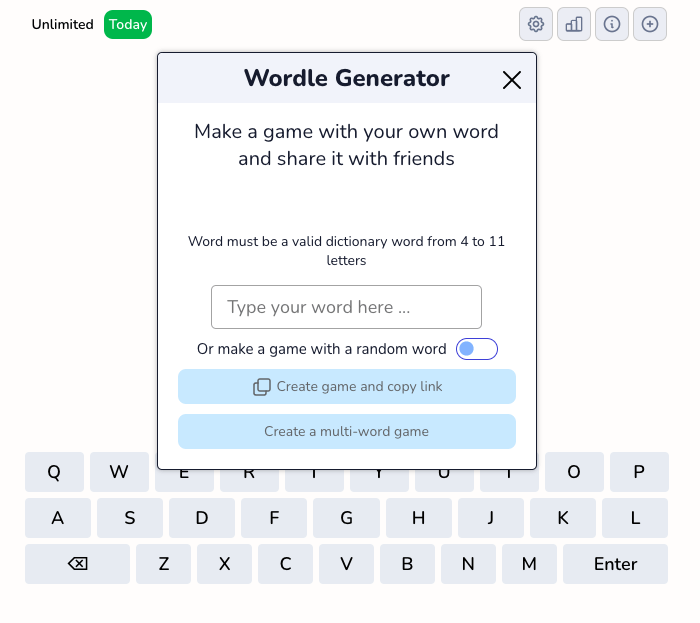
3. Production: If players want to challenge others to a word of their own, they can create their own Wordle game on the https://wordleplay.com/wordle-for-kids webpage by clicking on the (+) icon at the top right of the page. If we want to take Wordle off the screen and onto paper, it is very easy to set up a Wordle-like game (also could remind you of the class game “Hangman”) on a whiteboard, chalkboard, or even a piece of paper.
In the process of playing a Wordle game, it is easy to start creating our own words and mixing and matching letters together to guess a word we may have never heard of. During this process, our brain is producing and building words together, like one would in the BBC educational series Alphablocks, and using phonics and the process of elimination to produce the hidden word.
4. Risk-Taking: Wordle is all about risk-taking–it doesn’t matter if you get the answer wrong the first or second time because you have six tries to get it!
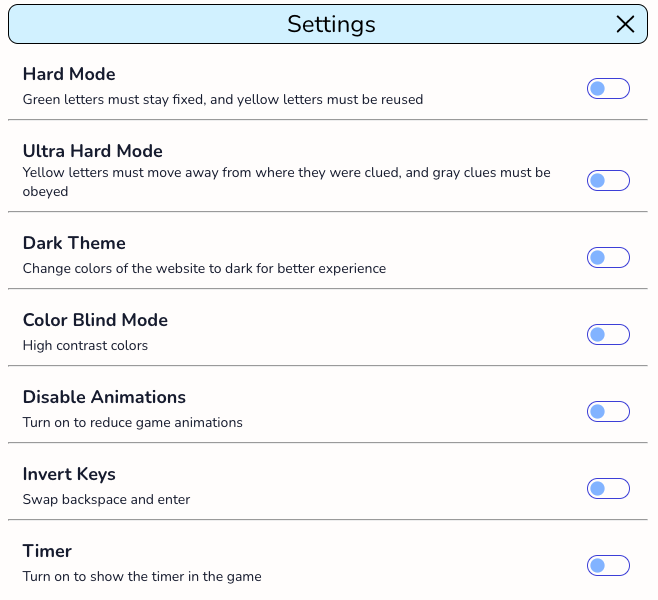
5. Customization: As discussed in the production criteria above, there are many ways to play the game, which means that the game can be customized to fit the player’s expectation. For example, those who find the standard version of Wordle too easy can switch their settings to hard mode, where every time the players reveal a letter, they must use that letter in any subsequent guesses, limiting their options to find as many clues as possible in the first few guesses. Also in the settings options, players can find colorblind mode, introduced after user feedback which explained some players could not spot the difference between green and yellow squares, colorblind mode changes the squares to more contrasting colors – orange and blue – making it easier to identify where letters should be placed.
6. Agency: In terms of agency, Wordle provides players with a high degree of autonomy and control over their learning experience. Players can choose to play the game at their own pace and within their own comfort level; this enables them to customize the game to their ability level and challenge themselves at their own pace. In addition, the game provides players with instant feedback on their performance, allowing them to learn from their mistakes and adjust their strategies accordingly. This feedback is critical to helping players develop problem-solving skills and improve their performance.
7. Well-Order Problem: In Wordle, players must use deductive reasoning to eliminate possible answers based on the feedback provided by the game. The process involves using trial and error to eliminate possibilities and make educated guesses based on the available information.
8. Challenge and Consolidation: Wordle presents players with a challenge by asking them to guess a five-letter word in a limited number of attempts. This challenge requires players to use problem-solving skills and logical thinking to eliminate possibilities and make educated guesses based on the available information. After each guess, the game provides feedback to the player, indicating which letters are correct and in the correct position, which letters are correct but in the wrong position, and which letters are incorrect. This feedback allows players to consolidate their understanding of letter combinations and improve their problem-solving skills over time.
9. “Just in Time” & “On Demand”: In Wordle, the “On Demand” approach is evident in the immediate feedback provided to players after each guess. The game provides players with information about which letters are correct and in the correct position, which letters are correct but in the wrong position, and which letters are incorrect. This feedback is provided in real-time, allowing players to adjust their approach and make more informed guesses in the future.
The “Just in Time” approach is evident in the limited number of guesses allowed in the game. Players must use their problem-solving skills and logical thinking to make educated guesses based on the available information, and are given only a limited number of attempts to do so. This approach promotes efficient learning, as players are encouraged to think critically and strategically about their guesses, rather than simply guessing randomly.
There is also a choice to “give up” if a player really cannot think of the answer. This gives the player an opportunity to end the game when they need and get the answer when they ask for it.
10. Situated Meanings: In Wordle, “Situated Meanings” can be seen in how players use their knowledge and understanding of language and vocabulary to make educated guesses about the five-letter word. The meaning of each letter is situated within the context of the other letters in the word, and players must use their knowledge of language and vocabulary to make sense of the word and its meaning.
11. Pleasingly Frustrating: In Wordle, the enjoyable frustration is reflected in the limited number of guesses allowed for each word. Players must use their problem-solving skills and logical thinking to make educated guesses based on the available information, but they are also given a limited number of attempts. This challenge creates a sense of tension and excitement that keeps players engaged and motivated to continue playing.
In addition, the game provides instant feedback after each guess, and this feedback allows players to adjust their approach and make more informed guesses, adding to the “enjoyably frustrating” nature of the game.
12. System thinking: In addition to vocabulary accumulation, players also need to have system thinking to help them win a game, which is to give meaning to these given letters from a big picture: what could be the connection between them, and if I choose a letter, how will it affect the following choices?
13. Explore, Think Laterally, Rethink Goals: To submit every word (hypothesis) of the six, players need to explore laterally for as many possibilities as they can, before moving down linearly. If the submitted word is incorrect, players need to reflect on and rethink the hypothesis and make adjustments accordingly.
14. Smart Tools & Distributed Knowledge: Playing this game, the players, us on the other side of the computer, tablet, or smartphone screen, work well together with a set of virtual characters inside the screen, the keys and colors on the Wordle keyboard, and use our knowledge of language and phonics in cooperation with the clues given by the smart keyboard to figure out the hidden word.
15. Cross-Functional Teams: As mentioned earlier, Wordle can be played in teams. Multiplayers in cross-functional teams help each other win the game efficiently. Some people have a relatively large vocabulary, some people are good at logical reasoning, some people are more familiar with consonant combinations, and some people learn phonics well. By understanding your own and other individuals’ skills, positively communicating and collaborating, players contribute each specialty to the success as a team.
16. Performance Before Competence: One player can play Wordle before he/she has competence in English vocabulary. Players can perform in the process of playing Wordle, by trying, getting timely feedback, interacting with group-mates, and achieving competence by constantly improving performance.
Stay inclusive, stay accessible, LET’S LEARN!
What are the barriers in the game?
The students have limited English vocabulary and knowledge of spelling patterns might get frustrated.
To play Wordle with papers and pens, untimely and incorrect feedback from the teacher/game host would affect the progress of the game.
The five-letter word in Wordle is an anagram, meaning it is a word formed by rearranging the letters of another word. Some players may struggle with anagrams or find it difficult to recognize the correct word from the scrambled letters.
Players have a limited number of attempts to guess the word, which can create a sense of time pressure and make it difficult to think through possible answers.
Who might be excluded?
To play Wordle, a device such as a computer, tablet, smartphone, etc. with access to the internet is needed; players who do not have access to these devices will not be able to play. If you want, you can play a pencil and paper alternative, but this only works in a multiplayer game.
The game uses the English language, therefore, individuals who do not speak or understand English may find it difficult to play and enjoy the game.
The game is text-based with no visual cues. Individuals with visual impairments may find it challenging to read and engage with the game, or even may not be able to play it at all without aided help.
How does the game foster creativity and critical thinking?
Have a different setting for the one game
Explore combinations of letters according to certain rules
Players must generate hypotheses or possible answers to the puzzle based on limited information, such as the number of letters in the word and any letters that have been correctly guessed.
Playing Wordle can help to expand players’ vocabulary by introducing them to new words and challenging them to recognize and use these words in context.
The game allows players to learn from their mistakes by providing feedback on incorrect guesses. Players must use this feedback to adjust their hypotheses and improve their chances of guessing the correct word.
What content is handled? What skills are being activated in the game?
The content handled could be English vocabulary, spelling and phonics in any level.
By playing Wordle, these skills of students could be activated: creativity and critical thinking, communication and interaction with other players, and deductive reasoning.
How will you assess if learning is happening?
The game statistics are the most direct form of assessment. The percentage of wins and how low the best try is can tell if learning is happening during the game. Since the teacher can make a game with a specific series of words, he/she can pick the words that students didn’t learn well to teach and play again later.
Of course, the teacher always can observe students while they are playing in the class, to assess what skills have been used in the process.
There are many ways to use Wordle as a fun learning tool in and outside of the classroom. We would love to hear about your Wordle experiences! Please share with us in the comments section below.
Andrea Haeussler: Middle School 6th, 7th & 8th Grade
Angelique Vives: Yearbook Class 9th, 11th & 12th Graders
Games played by Lucia, Andrea & Angelique
123, ABC
Students sit in a circle. The teacher or the started starts counting with 1 and passes it to the right. The next person passes 2, then the next one 3, and so on. When the student reaches 20, the next one starts with 1. Once the counting has been established, the teacher or started passes the ABC to the other side (opposite to where the numbers were sent). And the same process happens.
This is a spoon
Similar to the 123, ABC game. The teacher or starter starts the round going to the right (or left) passing a spoon and saying: “This is a spoon”. The person next to them says “A what?” Teacher responds: “A Spoon”. Studnet says “Oh, a spoon” and passes it to the next person, following the same dialogue. After about 2 or 3, the started passes the fork to the other side and follows the same dialogue.
Categories
Students stand in a circle. A category is selected. For example, countries. Everyone must say a topic from the category, in this case, a country. Rules: they can’t repeat the countries, they have to say it fast (no more than 3 seconds to think) and they have to be correct. If any of the rules are broken, they must sit out.
Connections
A person starts by saying a word, any word. The next person has to say a word that connects with the last word said. So if the first word was clouds, the next one can be sky. Then, the following person must connect to the last word said, so sky (not clouds). And so on. Rules: they can’t repeat the words, they have to say it fast (no more than 3 seconds to think) and the words have to connect and make sense. If someone makes a mistake, they must sit out.
Game played by Antonio Mayornick
Pictoword: Grade 6 (11-12 year olds)
Students read a series of pictures that combine to create a word. The series of pictures can be very simple and direct or the teacher can make it more challenging by making each syllable a different picture. The difficulty can also be increased by choosing pictures that don’t sound exactly like the word students are trying to figure out. A very simple example would be a picture of a stick of butter plus a picture of a fly. This word would be butterfly. A more difficult approach would be:
Students can play on teams or individually, the first person or team to say the correct word gets a point. If you’re writing the words on dry erase boards, teachers can have spelling count to earn the point.
What is Roblox? Roblox is an online platform for players to create games or play games other people have created, explore virtual worlds, and socialize with friends (or strangers).
Rules – Roblox has a set of Community Standards for all players as they interact with the many games and other players that are accessible on the platform. These community standards are broken into three categories; Safety, Civility & Respect, Fairness & Transparency, and Security & Privacy. Overall, Roblox encourages its community members, known as Robloxians, to “treat everyone with respect, both on and off of Roblox.
Objective – Roblox’s objective is to “build the metaverse: a space for people to adventure, experience, and explore.” It is a global community and Roblox wants to “ensure everyone feels welcome and safe and is treated with kindness and respect.”
Evaluation of the gameusing Gee’s 16 principles:
Identity- Players are able to build their avatar according to their own preferences. With Robux, players can purchase add-ons that further individualize their avatar. Due to the nature of virtual games, players can be anyone they want to be while playing Roblox!
Interaction- In Roblox games, there is a chat function where players may interact with one another. Each game is different, but in some of the games I tried playing, there were rules presented to me along the way. As I approached new stages or levels, new challenges were introduced.
Production – While there are many games available for play, some players choose to create and publish their own.
Risk Taking – Most games on this platform have a “checkpoint” feature, which allows players to reattempt portions of the game by trial and error. Users have the ability to take risks knowing there isn’t too much to lose.
Customization – Players can customize their avatars, they can create their own groups to play games, and they can create their own ”place” in the Roblox Studio. This “place” is similar to minecraft, where players have their own land and structures to personalize. The studio is where users can learn how to alter, edit, and design in their space and eventually their own game. Some games have different characters you can choose to play and you can customize their outfit in that specific game.
Agency – The players who choose to create their own games for others to play gain a strong sense of ownership and control over their own creation. For example, in “Theme Park Tycoon 2”, the owner has control over what they are doing and creating within the boundaries of the game. There are many creative features to adjust and explore within the game.
Well-Order Problems- There are levels or “stages” in games that are built on by prior stages. In Cotton Obby, for example, you learn to navigate on the first platform and all following platforms become more and more difficult to navigate. The skills are being built upon in each stage.
Challenge and Consolidation – You die in every game but there is the option to restart at the checkpoints you have passed.
“Just in Time” or “On Demand”- There is very little in the way of instruction or direction when you start a game, though in some of the games played, a character will tell you the directions for the level/stage you are currently working on. In other games, you can click a button that will allow you to read about game play upon your request only.
Situated Meanings – In “Scuba Diving at Quill Lake,” there are many places to explore and new vocabulary to learn throughout the game. Players can choose different areas to explore. Each area has specific landmarks, gear, and vocabulary for players to understand. The vocabulary is repeated and reinforced through images and actions within the game. This makes it very applicable and meaningful for players to explore and understand.
Pleasantly frustrating- Elements of this game can be frustrating, like not having control of your character or not being able to complete the task. You do “die” during the game, but then you come back to life and can try again. If a game is too frustrating, you are able to exit the game and find a different one to play. Some are much easier than others.
System thinking – Roblox has its own in-game currency called Robux, you can earn by creating games or by purchasing a gift card or subscription, which can be used to buy membership access to the Builders Club. With this, players can customize their character, known as an avatar, and improve their experiences in the game. Players engage in an exploration of Robux and what they create on the platform. How can they make money from what they create?
Explore, think laterally and rethink- Players can explore a variety of games, experiences, and skills. Since there are secrets hidden in games, players are encouraged to explore the entire map or capacity of the game before moving on.
Smart tools and distributed knowledge – Within the Roblox Studio, users design and interact with smart tools to create their own space. Users can design using Geometric or Physical planes, where you can account for collisions and other technical considerations.
Cross functional teams – Players can play games with other users they invite, or with anyone on the platform. Depending on the game, players have certain tasks to complete or roles to assume.
Performance before competence – Players can play any game on the platform before they ever decide to attempt to create their own game. Most games are exploratory and require players to navigate and explore the content before interacting with the game specifically.
Universal Design for Learning (UDL) Assessment
Reflection:
What are the barriers to the game?
The game has a Roblox Studio where each user can customize their own “place.” No navigation tutorial is provided.
Most customizable options or games require players to make a purchase.
Lack of prior knowledge about the game.
Only offered on computer, ipad, or cell phone. On the cell phone, you can’t play certain games.
You have to move the camera with a mouse and utilize the keyboard/space bar to walk and jump.
Anybody can talk to you in Roblox unless you specifically block users in settings.
Who may be excluded?
There are many free games available on Roblox, but there are also games that come at a cost which can be exclusive
This game is attractive to all genders (in one class of 26 second graders, 10 boys and 8 girls play Roblox on a daily basis as opposed to Minecraft where 8 boys and 1 girl play daily). Also, when signing up, the gender selection is optional.
How does the game foster creative and critical thinking?
Players can create their own games.
Choose your own adventure- There are endless games available to players! This allows for players to choose their preferred level of challenge.
Youtubers and other content makers make movies and simulations of their houses on Roblox.
There are secrets hidden throughout different games.
When players choose to create their own game, there are many creative features to choose from. The creator has the freedom to design his/her own game. The challenge is to make their design more desirable and attractive for more players to join and participate.
What skills are being activated?
If a player chooses to create their own virtual game, they will be required to code
Communication – with other players in the game or members of the roblox community.
Creativity
Resilience
How will I know if learning is taking place?
Leveling up – Players show they have gotten better at a game or have improved certain skills when they level up in a game.
Collaboration – Players develop interpersonal skills as they participate and strategize in games with others.
Coding – Users with effective code have playable games. Also, users show learning by troubleshooting their code.
Changes my students would make to Roblox:
If you get stuck in a game – there should be a way to keep going.