Jackbox is an online platform that allows users to stream multiple games. They can be adjusted for single or multi-use depending on the game that users decide to purchase. It is a gaming company that has always been conducive to social collaboration. Some games are for more personal relationships, requiring “inside” knowledge of a person, but some games are for all (including strangers!). This company really became popular during the pandemic, when all we had was communication and entertainment via a screen.
The Rules
Go to jackboxgames.com.
Select the game for purchasing and download STEAM.
Check your email for the access code (to your purchase). Create an account with STEAM and enter your access code to start the game.
Go to jackbox.tv and enter the room code on your cellular device.
Once users have created their own usernames and drawings, you are ready to PLAY!
What is Drawful 2?
The object of the game is to contribute drawings to be interpreted by your group. Chances are the artist may get ridiculously wrong answers! Users can log in by using their phone or tablet to draw funny and challenging things like “peeping donkey” or “cats at a disco.” Once logged in, players type in what they think the drawing is and then everyone contributes their answer. The drawer will choose the closest answer and that person will gain points.
Potential Barriers
Technology access: The App had different results depending on the OS on the device.
Linguistic Understandings: The game operates on English western logic, meaning that multiple meanings that would be easily surmised by a native English logic might need to be explained.
Motor skills and spatial awareness: The game requires individuals to apply a slight level of movement, which some students might feel reluctant to start altogether. Rather common in classrooms when there are assignments that require illustrations.
Who might be excluded?
Technology proved to be the main factor of exclusion. The application required multiple steps to set up for the entire group. It demanded the creation of a variety of logins and accounts for full coordination to happen.
Students who are shy at artistic self-expression would be a lot more hesitant to fully participate. Oftentimes students who are not adept at quick applications of art will feel judged despite the comedic element of the game itself. This can happen with students who are perfectionists by nature.
How does the game foster creativity and critical thinking?
This game absolutely fosters creativity. The whole objective of this game is to interpret a simple saying and draw how we interpret this. Obviously each individual has a different standard of drawing, so the creative aspect will have many different deliveries. Artists must critically think of how to deliver content in a way that can be understood by others. Players must put their minds in the artist’s and think how the provided prompt should be delivered.
What content is handled? What skills are being activated in the game?
How the game plays: everyone is given separate prompts, and has to draw an image matching that prompt. Then, the other players attempt to figure out what the drawing is, and write their own description. The most convincing description—the one all the other players vote for—wins that round.
The game activates the following skills:
Content can be created by students after reviewing the learning material in an anonymous form. Students will contribute to the subject target by creating visuals that can represent what was learned. Students rely on their prior knowledge to interpret an image with limited context. This requires critical thinking of each contributor.
Assessment of Learning
The learning in this game can be assessed when users are utilizing their logic to identify what pictures others users are creating. Users could be assessed on how well they present the picture through the game and how swiftly they are able to respond to the content that team members create. The created drawing will obviously display the understanding of the required prompt.
The game requires players to input titles for the illustrations. The students would have to refer to concepts from the learning material. Whether they are wrong or not, it does not matter as long they are approximating the concepts for further review and clarification.
The ability for the application to create its own specific concepts means this game can be used for any subject in a very efficient form. It is also very friendly for phone use, only requiring one host on a computer to operate it.
Takeaways
At first, the game was really difficult to understand how to download as we were all unfamiliar with how to use the platform STEAM. However, after a forty minute zoom, we were able to log back on to zoom and figure out how to start the game. We thoroughly enjoyed it and found that this could be especially beneficial for more complex subjects (science, historical events). Here are some highlights from us playing the game below.
Word Guessing (Ask 20 questions) by Simon Yan and Summer Xiao
Target Classroom: ELLs in any content area
Objective: Students will review English vocabulary from the unit/lesson by asking and answering yes/no questions to identify specific vocabulary words from memory.
A video demonstration of this Word Guessing game
Rules: • Students will work in groups of 4 to ask maximum of 20 questions to guess a word.
• Students will be each given 1 card to write down 1 key word they learned from a unit. All the cards will go to a hat.
• In each team, one student will draw an English vocabulary word from the hat. The other 3 students will take turns asking yes/no questions until they are able to guess the word correctly using the question structure, “Is the word …?”
• If students guess correctly, they will get the number of points equal to how many guesses they had left. For example, if a student guesses the word on the 5th question, they had 15 questions left so they receive 15 points.
• The team with the most points after a set amount of time wins!
Scaffolds: • Groups can be mixed or uniform proficiency levels depending on teacher preference.
• For lower proficiency students, teachers should consider creating a list of sample questions to make question formation easier. They may also consider the vocabulary that students can select from, although it is preferred to offer all students the same set of vocabulary.
• Teachers may offer translations for the student who picks the word so they know if the answers are yes or no accurately.
What are the barriers in the game? • Learning yes/no questions grammar structures
• Learning the kinds of questions that work the best in 20 questions (since some questions help to narrow down choices faster than others)
• Memory of unit/lesson vocabulary
Who might be excluded? • Lower proficiency students or students who struggle to remember the vocabulary may not be able to guess the word itself.
• However, they may ask another question to narrow down choices rather than guessing the specific word, ask a partner how to say the word in English, or use the question structure scaffolds to support the process.
How does the game foster creativity and critical thinking? • Students must create meaningful questions related to the context of the word they need to identify.
• Students must also reflect on unit vocabulary to ignore words they know are not the correct answer.
• Students must consider if a question accurately applies to a word’s meaning (yes) or does not apply (no).
What content is handled? What skills are being activated in the game? • This game can be applied to any content area as a review activity, but for our lesson it focuses on vocabulary learning.
• This activity requires speaking, reading, and listening skills as well as the creation of yes/no questions and identifying concepts from memory.
How will you assess if learning is happening? • If teams can gain points, then they are able to correctly ask about and identify concepts for the lesson.
• If students cannot remember words but remember them after a partner guesses correctly, or helps them to translate, then they have effectively reviewed.
By Angel Tillery, Amber Yafang Pang, & Judy Ying Zhu
About Wordle:
Wordle is a browser-based word guessing game, there’s no app to download, you just visit this website and get cracking. (You may need a certain VPN, or virtual private network, to access this website. If you are not able to access the site, here is an alternative link here.) The game gives you six chances to guess a five-letter word and each day the page is updated with a new word. The word is the same for all players globally.
Materials:
Any device with internet access
A notepad / paper
Rules:
The rules are very simple. You can play by yourself or in a group with others. All you need to do is use process of elimination to figure out what the final word is.
If we want to incorporate this game as a learning tool for students, we can use a point system:
At the end of a few rounds, we can see who has the most points!
In Wordle, we’re all winners!
Let’s see what happens when three friends get together for a good virtual session of Wordle.
Angel, Amber, and Judy play Wordle
According to James Paul Gee’s 16 Learning Principles of Good Games, this is how Wordle can be applied:
1. Identity: In this game, the players take on the identity of a game player, whether it is a single player game, a versus game, or a game played in groups in a “competition-style” game. When playing the “Word of the Day” Wordle, each player is involved in playing the same game in every part of the world; according to an article written on game blog fictionhorizon.com, Wordle had a daily user base of about 300,000 users a day during its peak in early 2022, before ownership was transferred to The New York Times (Jeijei, 2023).
2. Interaction: Wordle allows you to interact with people in many different ways:
You can play with a group of friends, working together to figure out the word
Students can play in teams, using a point system (orange letter 1 point, green letter 2 points, and full word 5 points) to compete for prizes for the most points
You can play the same game individually online through a website and share your results with other players on social media
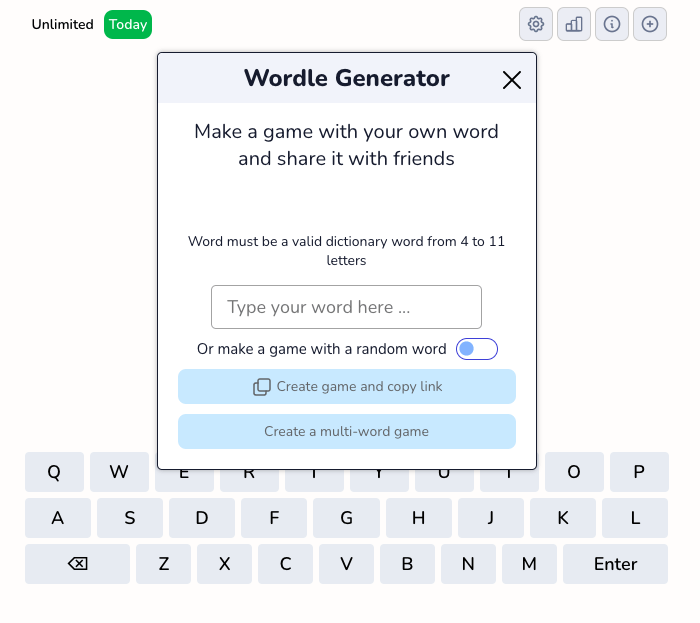
3. Production: If players want to challenge others to a word of their own, they can create their own Wordle game on the https://wordleplay.com/wordle-for-kids webpage by clicking on the (+) icon at the top right of the page. If we want to take Wordle off the screen and onto paper, it is very easy to set up a Wordle-like game (also could remind you of the class game “Hangman”) on a whiteboard, chalkboard, or even a piece of paper.
In the process of playing a Wordle game, it is easy to start creating our own words and mixing and matching letters together to guess a word we may have never heard of. During this process, our brain is producing and building words together, like one would in the BBC educational series Alphablocks, and using phonics and the process of elimination to produce the hidden word.
4. Risk-Taking: Wordle is all about risk-taking–it doesn’t matter if you get the answer wrong the first or second time because you have six tries to get it!
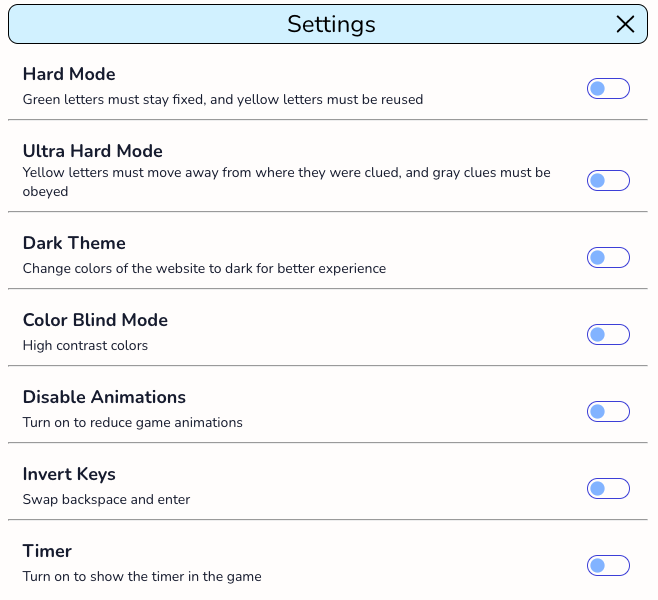
5. Customization: As discussed in the production criteria above, there are many ways to play the game, which means that the game can be customized to fit the player’s expectation. For example, those who find the standard version of Wordle too easy can switch their settings to hard mode, where every time the players reveal a letter, they must use that letter in any subsequent guesses, limiting their options to find as many clues as possible in the first few guesses. Also in the settings options, players can find colorblind mode, introduced after user feedback which explained some players could not spot the difference between green and yellow squares, colorblind mode changes the squares to more contrasting colors – orange and blue – making it easier to identify where letters should be placed.
6. Agency: In terms of agency, Wordle provides players with a high degree of autonomy and control over their learning experience. Players can choose to play the game at their own pace and within their own comfort level; this enables them to customize the game to their ability level and challenge themselves at their own pace. In addition, the game provides players with instant feedback on their performance, allowing them to learn from their mistakes and adjust their strategies accordingly. This feedback is critical to helping players develop problem-solving skills and improve their performance.
7. Well-Order Problem: In Wordle, players must use deductive reasoning to eliminate possible answers based on the feedback provided by the game. The process involves using trial and error to eliminate possibilities and make educated guesses based on the available information.
8. Challenge and Consolidation: Wordle presents players with a challenge by asking them to guess a five-letter word in a limited number of attempts. This challenge requires players to use problem-solving skills and logical thinking to eliminate possibilities and make educated guesses based on the available information. After each guess, the game provides feedback to the player, indicating which letters are correct and in the correct position, which letters are correct but in the wrong position, and which letters are incorrect. This feedback allows players to consolidate their understanding of letter combinations and improve their problem-solving skills over time.
9. “Just in Time” & “On Demand”: In Wordle, the “On Demand” approach is evident in the immediate feedback provided to players after each guess. The game provides players with information about which letters are correct and in the correct position, which letters are correct but in the wrong position, and which letters are incorrect. This feedback is provided in real-time, allowing players to adjust their approach and make more informed guesses in the future.
The “Just in Time” approach is evident in the limited number of guesses allowed in the game. Players must use their problem-solving skills and logical thinking to make educated guesses based on the available information, and are given only a limited number of attempts to do so. This approach promotes efficient learning, as players are encouraged to think critically and strategically about their guesses, rather than simply guessing randomly.
There is also a choice to “give up” if a player really cannot think of the answer. This gives the player an opportunity to end the game when they need and get the answer when they ask for it.
10. Situated Meanings: In Wordle, “Situated Meanings” can be seen in how players use their knowledge and understanding of language and vocabulary to make educated guesses about the five-letter word. The meaning of each letter is situated within the context of the other letters in the word, and players must use their knowledge of language and vocabulary to make sense of the word and its meaning.
11. Pleasingly Frustrating: In Wordle, the enjoyable frustration is reflected in the limited number of guesses allowed for each word. Players must use their problem-solving skills and logical thinking to make educated guesses based on the available information, but they are also given a limited number of attempts. This challenge creates a sense of tension and excitement that keeps players engaged and motivated to continue playing.
In addition, the game provides instant feedback after each guess, and this feedback allows players to adjust their approach and make more informed guesses, adding to the “enjoyably frustrating” nature of the game.
12. System thinking: In addition to vocabulary accumulation, players also need to have system thinking to help them win a game, which is to give meaning to these given letters from a big picture: what could be the connection between them, and if I choose a letter, how will it affect the following choices?
13. Explore, Think Laterally, Rethink Goals: To submit every word (hypothesis) of the six, players need to explore laterally for as many possibilities as they can, before moving down linearly. If the submitted word is incorrect, players need to reflect on and rethink the hypothesis and make adjustments accordingly.
14. Smart Tools & Distributed Knowledge: Playing this game, the players, us on the other side of the computer, tablet, or smartphone screen, work well together with a set of virtual characters inside the screen, the keys and colors on the Wordle keyboard, and use our knowledge of language and phonics in cooperation with the clues given by the smart keyboard to figure out the hidden word.
15. Cross-Functional Teams: As mentioned earlier, Wordle can be played in teams. Multiplayers in cross-functional teams help each other win the game efficiently. Some people have a relatively large vocabulary, some people are good at logical reasoning, some people are more familiar with consonant combinations, and some people learn phonics well. By understanding your own and other individuals’ skills, positively communicating and collaborating, players contribute each specialty to the success as a team.
16. Performance Before Competence: One player can play Wordle before he/she has competence in English vocabulary. Players can perform in the process of playing Wordle, by trying, getting timely feedback, interacting with group-mates, and achieving competence by constantly improving performance.
Stay inclusive, stay accessible, LET’S LEARN!
What are the barriers in the game?
The students have limited English vocabulary and knowledge of spelling patterns might get frustrated.
To play Wordle with papers and pens, untimely and incorrect feedback from the teacher/game host would affect the progress of the game.
The five-letter word in Wordle is an anagram, meaning it is a word formed by rearranging the letters of another word. Some players may struggle with anagrams or find it difficult to recognize the correct word from the scrambled letters.
Players have a limited number of attempts to guess the word, which can create a sense of time pressure and make it difficult to think through possible answers.
Who might be excluded?
To play Wordle, a device such as a computer, tablet, smartphone, etc. with access to the internet is needed; players who do not have access to these devices will not be able to play. If you want, you can play a pencil and paper alternative, but this only works in a multiplayer game.
The game uses the English language, therefore, individuals who do not speak or understand English may find it difficult to play and enjoy the game.
The game is text-based with no visual cues. Individuals with visual impairments may find it challenging to read and engage with the game, or even may not be able to play it at all without aided help.
How does the game foster creativity and critical thinking?
Have a different setting for the one game
Explore combinations of letters according to certain rules
Players must generate hypotheses or possible answers to the puzzle based on limited information, such as the number of letters in the word and any letters that have been correctly guessed.
Playing Wordle can help to expand players’ vocabulary by introducing them to new words and challenging them to recognize and use these words in context.
The game allows players to learn from their mistakes by providing feedback on incorrect guesses. Players must use this feedback to adjust their hypotheses and improve their chances of guessing the correct word.
What content is handled? What skills are being activated in the game?
The content handled could be English vocabulary, spelling and phonics in any level.
By playing Wordle, these skills of students could be activated: creativity and critical thinking, communication and interaction with other players, and deductive reasoning.
How will you assess if learning is happening?
The game statistics are the most direct form of assessment. The percentage of wins and how low the best try is can tell if learning is happening during the game. Since the teacher can make a game with a specific series of words, he/she can pick the words that students didn’t learn well to teach and play again later.
Of course, the teacher always can observe students while they are playing in the class, to assess what skills have been used in the process.
There are many ways to use Wordle as a fun learning tool in and outside of the classroom. We would love to hear about your Wordle experiences! Please share with us in the comments section below.
By: Chelsea Yangirelfil, Maria Simeon, and Yijia Zhao
Description: The main objective of the module is to explore and analyze a game as a creative multimedia technology. The goal is to explore how games can be creatively utilized to address skills objectives and meet existing standards. Games and play are great because they typically involve multiple domains of learning simultaneously and seamlessly: psychological, social, emotional, as well as content.
Escape Room
Objective of the Game: Students will be able to explore and answer questions to escape the pirate ship.
Game Site: https://online-escape-room.com/
Escape Room Introduction Video
Escape Room Game Play
Escape Room Discussion
Escape Room Bloopers
Questions To Consider
Question #1: What are the barriers in the game?
Internet speed – Without fast-speed internet, the game cannot be streamed. So students without internet access or fast internet might feel frustrated and excluded in the game.
Lagging computers – Frozen screen and lagging computers might add to the frustrations.
Lacking devices – Students need to have at least one digital device to play the virtual Escape Rooms game. The device can be a smartphone, iPad, or laptop.
Only one screen – When playing the game, we realized it would be so nice if we could have multiple screens, for example, one screen for the map, one screen for the clue, one screen to answer the questions, etc. Having multiple devices could be really helpful. That’s why we encourage teamwork.
Limited open-ended questions – The questions we answered cover a variety of subjects, Math, English, science, however, most are not open-ended questions. We need to think of ways to incorporate more open-ended questions into the game.
Limited space – If we were to design/create a physical escape room, limited space in school/classroom is a challenge.
Time consuming – it is very time-consuming when teachers or students try to design/create the game. Teachers might want to work as a team. It can be an end-of-the-year group project for students as well.
Question #2: Who might be excluded (without proper support)?
ELL students who might have difficulty understanding the language spoken, and the text displayed in the game. When we are grouping the students, we need to take that into consideration.
Some students with IEP might be excluded if there is no proper support. For example, some students might need the text displayed to be read out loud.
Questions #3: How does the game foster creativity and critical thinking?
Students get to explore and problem solve throughout the game.
Students are retrieving prior knowledge when answering questions.
Students are thinking outside the box.
Students can reflect on their learning and relate it to real-life situations.
We can customize the game so there are more ways to “escape”. We can also design it to adapt to students’ learning styles.
The game has a theme (for example, the one we did in the video was called “Pirate Panic”). We can have different themes and give students choices to choose one or create their own theme.
Questions #4: What content is handled? What skills are being activated in the game?
We can include a variety of subjects. The questions in the Escape Rooms game can be for any subject areas (for example, the game we played had math, cardinal directions, Language/Vocabulary). We can also include Social Studies and Social Emotional Learning (SEL)
Skills being activated :
–Problem-solving
–Critical thinking
-Teamwork
–Awareness skill (be aware of your surroundings)
–Creativity
Question #5: How will you assess if learning is happening?
We can assess student learning throughout the game when students are answering the questions and figuring their way out.
We can assess the language used during the game.
We can assess the interaction and teamwork between the students.
Gee’s 16 Principles
Identify – Provide students character profiles or identification that are connected to the escape room’s subject.
Interaction – To unlock the series of tasks, students must interact with one another and exchange knowledge.Students work as a team (one leader, two supporters) and they can communicate and solve problems together.
Production – Students can take part in creating the hands-on interactive creation of the “escape rooms”.
Risk Taking – Educate students to decision-making or timed problems that need risk-taking. Students are able to take risks and continue playing. They can try the game again even if they fail.
Customization – Offer many paths for resolving riddles or optional challenges to give students the option of customizing their gameplay experience. Students can choose game sets that align with their interest and subject matter allowing them to be more engaged.
Agency – Identify opportunities for students to make decisions and take actions that directly affect the game.Students get to choose a theme for the game and they can also take part in creating the game, so they have a real sense of ownership over what they are doing.
Well-order problems- Create challenges and riddles that get tougher over time so that students can improve their abilities and knowledge as they move through the game. The Escape Room Games will have step by step instructions and questions for the students to answer in order. They are able to either answer them in order or to explore freely.
Challenge and consolidation – It allows students the chance to reflect on what they have learned after surpassing the challenges.The Escape Games will not have the adaptive system to create questions created for each specific student. The questions are already set.
“Just in Time” or “On Demand” – The hints (“on demand”) are placed when students get stuck on a problem, they have the option to get help (sometimes it is limited from 2 up to 11 hints) and these hints are useful. When we answer a question correctly, we get the clues “just in time”. These clues should be properly placed to offer help when it’s needed, ensuring that students get help just in time to keep the game moving forward.
Situated Meanings – Students can match the obstacles and riddles to the escape room’s general concept and narrative. They are able to utilize and learn different vocabulary words as they explore. They are able to relate the words to the events and images or symbols in the game.
Pleasantly frustrating – Create tasks that are challenging enough to encourage students to use their critical thinking skills and to persevere and explore in order to find solutions. The game is doable but challenging. Throughout the game, we get stuck on certain questions but eventually we figure it out as a team.
System thinking : Students need to manipulate and comprehend the causal connections about what events will happen from their decisions. As they explore and solve questions, they will think critically about how the game will react as well as their team players.
Explore, think laterally and rethink – The game gives the opportunity for exploration and discovery as they try to escape. Students can go back and forth through the questions and hints to help them solve the problems.
Smart tools and distributed knowledge – Students can use digital tools such as tablets and laptops and software designed for cumulative data and record keeping, simulating real data learning and integrating the game-like experience to improve educational results.
Cross functional teams – It is a multi-player game. Students get to play in teams and each player has a different set of skills (teacher can keep that in mind when grouping students).Teamwork and knowledge sharing are crucial to succeed.
Performance before competence-“Learning by doing” Students can learn to play the game while exploring the game. Students are performing all throughout the learning process. They learn through exploration and go beyond what is expected.
Escape Room Experience in Seoul
I was able to travel to Korea in April and experience an actual escape room. It was amazing and the riddles were very fun to solve. Communication and Teamwork was a big factor in solving the riddles and escaping the room. Comparing the two experiences (online and physical), each of them has their own advantages and disadvantages. Both of them encourage a lot of problem solving and critical thinking. It was also challenging and involved a lot of prior knowledge retrieval. Students would definitely enjoy these types of games in the classroom.